

180 Faces of God

There are many important things that science readily admits it doesn't understand, like dark matter, dark energy, consciousness, abiogenesis, or quantum gravity.
God and any variation thereof is an unfalsifiable hypothesis. Yes, someday, it could be verified as true, for example, if god, aliens or simulators someday choose to directly reveal themselves. Or alternatively, if adopting one of these beliefs consistently leads to an improbably high success rate in whatever you set out to do. But these hypotheses could never be proven false, as whichever entity we are referring to (god, alien or developer) would be so far beyond us in technical capability that any evidence suggesting these hypotheses are not true could itself be a intentional misdirection.
This aspect is what puts God beyond the realm of traditional science. While the scientific method could well be utilized to demonstrate that certain concepts of God are more likely, it could never truly disprove any of them.
God is also unique because each person has their own idea what god means. The word itself evokes an automatic emotional response.
What emotion did reading this article's title, or seeing the above image automatically evoke in you? Now, take a moment, think deep about what caused this emotion. Take a best guess, what prior assumptions have you made about god that account for this emotion. What prior traumas of pleasant memories do you ascribe to god, and how do they bias you? What you did is the first and most imporant step, to a better way to assess possibilites. Bayesian Inference.
God is strange. It/he/she/we (whichever best aligns to your prior biases) could be true without violating known science, because, aside from Bayesian Inference and our own minds, we simply do not even have the right instruments, concepts, perceptual bandwidth, mathematics, or metaphysics to weight the possiblities.
Below are 180 different perspectives of God. Each and every single one of the theories below happen to align perfectly with all known science.

##0. God Per Ancient Religions - All Surviving Ancient Spiritual Texts Were Correct.
Not One. Every Single Major Religion and Every Surviving Ancient Writing Were Correct. The fact that these are the ideas that survived, these were the societies, writings, and ideas that proved the most fit through the stress filled crucible of human evolution, requires that we give them atleast a modest probability of being correct. By that same logic, we should also give the ideas about god expressed by the greatest scientific minds in human history a high probability as well, since they all happen to perfectly align with god as portrayed in the below video: https://youtu.be/ADYdypHZb2A?si=tGAOOTFZsS8fSTz8
That video, presented by Chase Hughes, explores the idea that ancient civilizations, despite being separated by vast geography and centuries, arrived at the same fundamental truths regarding the structure of reality and human nature. Thus, these are not religious myths but rather a coherent "model" of reality that humanity has collectively observed.
The Five Fundamental Truths:
I. You are not separate: The core message across all traditions is that individual separation is an illusion. We are part of a single, unified field of consciousness, often compared to a wave in the ocean that is never truly separate from the water itself.
II. Fear is an illusion, Love is the truth: Fear is identified as a lie that keeps us asleep and isolated, while love represents alignment and the recognition of our shared nature. Fear is biologically incompatible with our true state.
III. The mind shapes reality: Your mind is not a camera recording reality but a projector constructing it. Our internal stories, fears, and beliefs serve as filters that shape our experience of the world.
IV. The enemy is the ego: The ego is described as a protective mask or survival mechanism built from fear. It craves hierarchy, conflict, and separation. To experience truth, one must look past this "hallucination" of self.
V. Everything is connected: Nothing exists independently. Every action and thought radiates through the whole system. We are essentially neurons firing within a cosmic brain.
Humanity didn't lose this knowledge through conspiracy, but through the development of survival habits. As we built civilizations, fear became a tool for resource protection, which eventually hardened into a culture of materialism, comparison, and constant distraction. We traded silence and contemplation for dopamine-fueled noise.
The Five Paths to Awakening:
Awakening is not about adding new beliefs, but stripping away the noise that cause negative emotions. Main stream Science agrees that this can be achieved through five methods:
I. Truth/Radical Acceptance: Confronting reality as it is, without fear, rather than running from it.
II. Presence/Mindfulness: Living in the current moment, as the future and past are constructs of the mind.
III. Compassion/Love: Recognizing others as extensions of oneself.
IV. Stillness/Meditation: Using self-knowledge to remove the distortions of the ego.
V. Transformation/Growth: Viewing suffering not as a tragedy, but as a catalyst for wisdom.
Awakening is simply the act of remembering what you have always been, leading to a state of relief where the pressures of the ego no longer hold authority. Charles Hughes put the ideas together beautifully. But as he argues, this idea does not belong to him, it belongs to all of u.
The idea goes by many names, and they share almost everything in common with the views of god expressed by many of the brightest and most successful people in recorded history.
Many philosophies and religious teachings the past ten thousand years said much the same:
Advaita Vedanta
Buddhism
Zen Buddhism
Tibetan Buddhism
Daoism
Sufism
Christian mysticism
Kabbalah
Neoplatonism
Hermeticism
Gnosticism
Hindu Tantra
Kashmir Shaivism
Indigenous animism
Shamanism
Stoicism
Many famous scientists and philosophers also said much the same:
Eckhart Tolle
Alan Watts
Ram Dass
Marianne Williamson
Jiddu Krishnamurti
Rupert Spira
Thich Nhat Hanh
Donald Hoffman
David Bohm
Carl Jung
Robert Lanza
Bernardo Kastrup
Erwin Schrödinger
Aldous Huxley
Ryan Holiday
Marcus Aurelius
Epictetus
Andy Weir
Ken Wilber
This idea is the opposite of emergence from bottom up on the complexity scale. This idea is Ingression, a top down view of the world. Many popular theories propose the same:
Perennial philosophy
Prisca theologia
The Collective Unconscious
Traditionalism
Interface Theory of Perception
Comparative mythology
The Implicate and Explicate Order
The monomyth/The Monad
Biocentrism
The Power of Intent
Evolutionary Game Theory (as applied to perception)
The hero’s journey
"The Egg" (Short story by Andy Weir)
The Let Them Theory
A Course in Miracles (Spiritual Text)
The Matrix (Film allegory for the illusion of reality)
Archetypal theory
The collective unconscious
Universal mythic structures
The "Universe Experiencing Itself" - 1 Ate 0
Various Other Viral Ideas
The Secret - That book that Oprah Winfrey and many other billionaires swear by.
As such, this idea does not belong to anyone person, culture, religion or era. I asked ChatGPT to add to the above list and unless it hallucinatinated them, the full list of philosophies and famous people that said much the same is far larger. I included that more comprehensive list at the very bottom of this article as Citations - List of People & Philosophies that Endorse V. Perennial Philosophy!
It is an idea that was and remains popular through every single era of human history. And that is perhaps its most compelling trait. It is also the reason I would assign this a much higher probability than scientific materialism, which has suffered a long string of failures for the past 500 years.

## 1. The Simulation Hypothesis - God as our Developer
The universe may be running on an information-processing substrate that is not itself part of our universe.
That doesn’t have to mean we are The Sims in a videogame being played on a quantum computer. It could also mean a higher-order computational reality where what we call “matter” is the rendered interface of deeper information dynamics.
Much like god is unfalsifiable, a simulated physics engine would not necessarily be detectable from inside the simulation. The only hints it would offer would be artifacts of rendering limitations such as pixelation (ie. Planck’s lenght and Planck’s time), and a universal speed limit that nothing could exceed, to enable frustrum culling, a techinque routinely used in our own simulations to avoid wasting resources rendering anything that isn’t actively being observed by a conscious agent.
This idea was popularized by Nick Bostrom, and the math is difficult to argue with. He argues:
A technologically advanced civilization might eventually gain enough computing power to run extremely detailed simulations of conscious beings, entire societies, or even whole histories. If that becomes possible, and if advanced civilizations are interested in doing it, then simulated minds could vastly outnumber “original” biological minds.
So Bostrom’s logic lands on a trilemma. At least one of these is true:
Almost all civilizations go extinct before reaching technology capable of running advanced simulations. Or...
Atleast some advanced civilizations do reach that level, but none choose to run many ancestor simulations. Or...
We are very likely living in a simulation.
If any one real civilization over the course of however long the species span ends up being, creates billions or trillions of simulated conscious observers, then statistically, most conscious observers would be simulated rather than biological.
Humanity already appears close to disproving the first possibility, and may well disprove the second within a generation, leaving only the third. It’s like discovering that a city has one real casino and a million VR casinos with conscious avatars inside. Pick a random gambler, odds are they’re in VR.
“Given future computing power, artificial consciousness, and large-scale simulations, you can’t casually assume we’re the base reality.” The math makes that assumption fragile.

## 2. Higher spatial dimensions - God as a greater mind, to whom we are mere neurons
Many of the our best attempts to reconcile Relativity and Quantum Mechanics involve higher dimensions. M-theory, various other brane models, holography, quantum gravity and string theory all involve several extra dimensions. My personal favorite, M-theory (and some of the others) is commonly associated with eleven-dimensional spacetime and branes that are not compactified, and could thus allow for the emergence of higher dimensional matter.
Scientifically speaking, now that the existence of super massive black holes have been verified multifold. If true infinity is impossible in our universe, then higher dimension are necessary. If a black hole's singularity isn’t a real infinite point, our four-dimensional world hits a limit as to how much matter, how much information any singularity could hold.
The unknown unknown is not just “there are extra dimensions.”
It’s that entities, processes, or forms of organization could exist in higher-dimensional structure while only casting partial shadows into our 3D world. Our entire reality would be a tiny infinitesimally part of a higher dimension.
If higher dimensions exist physically, then life of some form, is likely to emerge within them. Emergence shows up literally everywhere in science, at each layer in every field of science, even the social sciences. Science shows us again and again that anytime a system has even a bit of complexity, unique properties emerge that are nothing like those possessed by the constituents. Emergence is the current scientific consensus for all three hard problems, how matter, life, and consciousness each arose.
Such life would not necessarily look like organisms. It could be field-like, geometric, topological, computational, or brane-bound. If the patterns holds as emergence has thus far, we should expect that ever grander more beautiful things emerge at higher layers, things that we couldn't even begin to understand as they maybe so far beyond us in complexity, as the properties of life are beyond the properties of the basic elements that constitute it. Perhaps a supraconscious entity that exists above us, much as we exist at a higher level of consciousness than the very living and brilliant cells from which we are formed.
To us, it might appear as anomalies, coincidences, God, impossible synchronicities, quantum weirdness, or nothing at all.
A 3D hand passing through a 2D world looks like a miracle to the square. If you dont understand that analogy, you really should watch Carl Sagan's wonderful explanation of Flatland: https://youtu.be/UnURElCzGc0?si=_JNVRlGms4-Crk6p
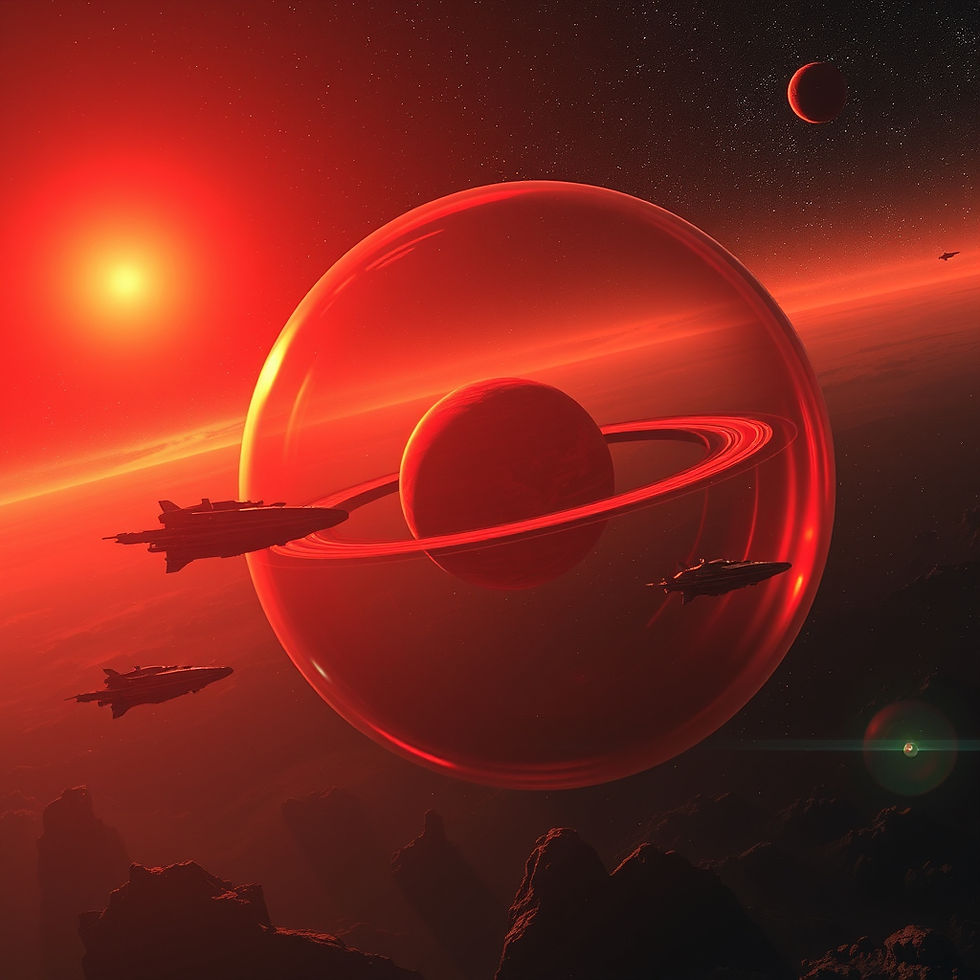
## 3. The Zoo Hypothesis - Aliens
The zoo hypothesis says advanced extraterrestrials may know we exist but intentionally avoid contact, perhaps to let us develop naturally, avoid contamination, study us, or wait until we meet some threshold. It is one proposed answer to the Fermi paradox. And it is the most obvious one. Any species capable of interstellar travel would be generations ahead of us technologically. For such a species, hiding all evidence of their existence would be child’s play.
This is an extremely fun theory to speculate about in part because it would not rule out any of the other possibilities. Higher dimensional lifeforms, and simulators could all exist along side third dimensional aliens.
Maybe the silence is policy, because the math makes it near impossible that we are actually alone. Our best planet-hunting telescope Kepler, suggests roughly 1 in 5 stars host an Earth-like planet. There are ~400 Billion stars in our galaxy, the Milky Way, implying ~80 BILLION Earth-like planets in our Galaxy. The observable universe contains ~1-2 TRILLION GALAXIES.
Meanwhile, SETI, our "hunt" for evidence of life, is so technologically limited, that it would be incapable of picking up signs of life even if a species identical to current day humanity existed in a neighboring solar system. The only thing SETI could find is if a technologically advanced civilization used a large amount of power to send a EM beam directly pointed at Earth. And how far away they are from us would play the biggest role in whether the signal would reach us as visible light, microwaves or as something like the narrow band radio WOW signal, how that signal would be distorted by background interference over it's long journey, and which signal processing algorithms are the best approach to transforming it into something SETI's transducers might even notice.

## 4. There may be meta-laws selecting laws - And the selector is God
Even if we discover the laws of physics, we still need laws that explain why those laws. One of science's biggest unknowns are the Goldilock's Constants, the long series of coincidences, of fundamental forces, and physical laws that fall within a very small range of possibilities, that allow matter and our universe to even exist. We remain clueless why so many fundamental laws and physical constants appear fine tuned, that the scientific consensus relies one meta-law: Observers can only exist within a Universe that happens to be perfectly fine tuned to allow for complex matter, and eventually Observers.
However, the meta-laws behind laws do not just govern the laws of physics:
I. Elon Musk once posited that Our universe always seems to favor the more entertaining outcome. This often does seem to be the case, which has some fun implications about some reasons why we exist.
II. Most religions and cultures hint at a meta-law of a guiding force leading humanity to one of the many possible kick-ass futures for our species. The nature of such a force could be well beyond our comprehension, but it helps to label it with an easy to understand term: God, Simulators, Aliens or Higher Dimensional beings that can access something akin to a 4D Tesseract made up of humanity's many possible Block Universes: https://www.youtube.com/watch?v=uhMmix3i6EM At the heart of this meta-law is the assumption that we matter, humanity matters, for reasons that may lie beyond our current capacity for understanding.
III. "There is a theory which states that if ever anyone discovers exactly what the Universe is for and why it is here, it will instantly disappear and be replaced by something even more bizarre and inexplicable. There is another theory which states that this has already happened." - Doug Adams brilliantly posited in the Hitchhiker's Guide to the Galaxy
IV. Popular self-help books keep circling the same strange meta-law, even when they dress it up in different costumes. The 48 Laws of Power says reality bends toward people who understand incentives, status, timing, and social physics. The Power of Intention and The Law of Attraction argue that attention is not passive, it acts like a steering wheel for behavior, perception, and opportunity. Happiness research says your inner state changes what you notice, pursue, and tolerate. The “Let Them” theory is the cleanest modern version: stop wasting energy controlling other people, reclaim your agency, and let reality reveal itself. In short: Trust the Universe.
Underneath all of these is the same basic meta-priniciple, your mind is not just observing life, it is constantly altering your posture toward it. Yes it could be that your mind is simply changing what you notice, how you perceive events, what intent you ascribe others, what opportunities you notice, pursue, and ultimately what future unfolds. Perhaps it goes beyond even that, some of the most popular theories embraced by some of the most successful people insist on a meta-law that your mind directly alters your reality and actualizes your future. So lower your ego, the universe may know better than you about your subconscious fears, your innate assumptions, and your real needs. Happiness, power, love, luck, and peace may look like separate topics, but they all orbit one well validated meta-law: where attention goes, emotion selects, identity shapes, behavior follows, opportunities arise and futures change.
V. I will eventually write a longer article doing a deep dive one the various meta-laws that seem to be true, or popular. But the deeper question is, why do these meta-laws seem to work and how did they come to be. Maybe the deepest unknown, the last algorithm, is law-selection.

##5. The laboratory Earth hypothesis - Alien Scientists as Gods
This takes it one step beyond the zoo hypothesis (4) above.
Aliens aren't just hiding from us to help us preserve our culture. Earth may be observed as a biological, cultural, psychological, or evolutionary experiment.
Not necessarily “aliens built pyramids.” Though that is not impossible.
The more serious version is that advanced civilizations could monitor planets at astronomical scale without needing visible contact. They could even intervene without our awareness. At best, alien intervention (or the byproduct of humans secretly reverse engineering their technology) would be one possible explanation for the extraordinary pace of human technological progress in recent times, and the fact that we haven't already destroyed ourselves with nuclear weapons or bioengineered viruses.
We already monitor animal populations, weather systems, forests, ocean temperatures, and microbial environments without asking permission. When possible, we try not to interfere, but we do quietly intervene when needed to save the bees, to undo damage we contributed to, or to build a firewall to stop a wildfire's path of destruction.
The Voyager 1 just discovered a 30,000–50,000 Kelvin "bubble of fire" plasma region at the edge of the solar system (heliopause) that completely envelopes us. The Sun's surface (photosphere) is approximately 5,772 to 5,800 Kelvin for comparison. There is a scientifically plausible explanation for such high temperature bubbles occurring in the vacuum of space. Don't Panic... this fire bubble that our solar system resides within isn't necessarily a cage to keep us in, or to keep something out. We just can't rule out that possibility.

## 6. The “training environment” universe - We are learning to become God
A subset of the simulation hypothesis. Maybe our universe is not merely simulated for entertainment or historical study. Maybe it is a training environment for minds.
Souls, agents, intelligences, or consciousness-fragments could be placed inside constrained physical worlds to develop decision-making, empathy, courage, creativity, or moral intelligence.
This theory is spiritually ancient, dating back atleast 4000 years to the Upanishads, but it is also oddly compatible with computational metaphors.
Andy’s Weir’s excellent short story ‘THE EGG’ does a beautiful job exploring this possibility:

## 7. Hidden sectors of physics - Dark Matter & Dark Energy as God
There may be particles, fields, forces, or interactions that barely couple to ordinary matter.
Dark matter already hints at this kind of possibility. But there could be entire hidden sectors with their own complexity, chemistry, structures, or “life,” while remaining nearly invisible to us.
Imagine an ocean inside the room that only interacts with us gravitationally.

## 8. Dark matter ecology - God as Emergent from Dark Matter Dark Energy Interactions
If dark matter has rich self-interactions, it may form structures more complex than we currently imagine.
Maybe there are dark stars, dark chemistry, dark biospheres, or dark information-processing systems.
Highly speculative. But it doesn’t contradict the basic fact that dark matter interacts weakly with ordinary matter.
It would mean we’re sitting inside a haunted mansion and only seeing the wallpaper.

## 9. Consciousness-first reality - God as Universal Consciousness
Maybe matter does not produce consciousness. Maybe consciousness produces the appearance of matter ie. Ingression.
In this view, brains do not generate consciousness in the way a liver generates bile. Brains may filter, localize, constrain, tune, or render consciousness, more like a radio tuning a broadcast.
Donald Hoffman’s interface theory argues that perception is not a transparent window onto reality, but an adaptive user interface shaped by fitness, not truth.

## 10. The next Copernican humiliation - God is us, once Ego is removed
Perhaps not God in the traditional sense, but as an unknown structure or a universal Will emergent from individual and collective Intentions, shaped by Attention and serving us Copernican humiliations
We simply are not yet meant to know the full truth.
Certainity is a Cognitive Bias every single one of us has that fulfills several subconscious needs, but too much certainity is ego driven and often leads to our pitfalls. Thus the last algorithm of the architecture finds ways to humble any subset of population that finds themselves fully certain of one insular simplified worldview. Whenever scientists find themselves over confident, clinging to one worldview rather than exploring alternatives, reality tends to serve them Copernican humiliations.
First, Earth wasn’t the center.
Then humans weren’t separate from animals.
Then conscious intention wasn’t always master of the mind.
The next humiliation may be that matter is not fundamental, human logic is not ultimate, or our universe is not the main event.
Whatever it is, it seems increasingly likely that the next humiliation will give excite us, perhaps by revealing evidence of an afterlife, a higher dimension, the power of intention, Schopenhauer’s universal will or alien technologies that our current scientific consensus labels “impossible.”
## 11. We may be in the pre-instrument era for metaphysics
Before microscopes, microbes were not “unscientific.” They were inaccessible.
Before telescopes, galaxies were not “mystical.” They were unresolved smudges.
Maybe consciousness fields, higher dimensions, nonhuman intelligences, or deeper informational structures are currently in the pre-instrument stage.
Not proven. But history says humility is cheap insurance.
## 12. There may be truths only accessible by altered states
Meditation, psychedelics, dreams, near-death experiences, flow, prayer, trauma, grief, awe, and deep love may reveal aspects of mind or reality not accessible in ordinary waking cognition.
Science can study the correlates, but the first-person content may resist full third-person capture.
A telescope changes what you can see. Maybe states of consciousness are telescopes too.
## 13. The universe as a cognitive system
If cognition exists at cellular, organismic, social, and technological scales, maybe the universe itself has proto-cognitive structure.
Not necessarily “the universe thinks like a person.” That’s too crude.
More like, the universe may process possibilities, update states, stabilize patterns, and generate internal observers.
## 14. The ruliad
Stephen Wolfram’s ruliad is the idea of an ultimate structure generated by all possible computational rules followed in all possible ways. Wolfram describes it as the “entangled limit” of all possible computations, with observers like us sampling only a tiny slice of it.
The unknown unknown here is enormous.
Maybe physics is not the deepest layer. Maybe physics is what a bounded observer experiences when embedded in a larger computational object.
That’s basically Plato’s cave, but the cave is composed of computation.
## 15. Rulial space as a hidden geography of possible realities, explored by our Collective Intention or by Schopenhauer’s Universal Will
If the ruliad exists, then our universe may be one region in a vast space of possible rule-systems.
Different observers might experience different physics depending on their location, structure, constraints, and sampling method.
## 16. Mathematics as discovered territory
Gödel’s first incompleteness theorem says that any consistent formal system strong enough to express arithmetic contains statements that are true but not provable within that system.
His theorem shows that not only is mathematics incomplete, but that it is impossible for any logic based system, such as math to be complete.
Math is larger than any rulebook we could ever even formally build. Formal systems may be boats floating on an ocean of truth they can’t fully contain.
## 17. Mathematical Platonism
Maybe mathematical objects exist independently of human minds.
Numbers, sets, geometries, symmetries, logical relations, Hilbert spaces, and category-theoretic structures may not be inventions. They may be discovered.
If so, physical reality may be one expression of mathematical reality, not the other way around.
Matter becomes math wearing a costume.
## 18. The universe as a theorem
Maybe reality is not made of stuff. Maybe it is the unfolding consequence of a necessary mathematical structure.
This is close to Tegmark’s mathematical universe hypothesis and also resonates with Wolfram’s “all possible rules” picture.
The unknown unknown is that existence itself may not be contingent. It may be logically forced. And solving is our impossible last algorithm.
## 19. Other logics beyond human logic
Human reason may be one local cognitive tool, shaped by survival.
There may be other valid logics, other modes of inference, other forms of consistency, other mathematical worlds, other ways of knowing, that our brains cannot naturally access.
An ant can’t do calculus. Maybe humans can’t comprehend the real scope of reality.
## 20. The multiverse
Our observable universe may be one bubble in a much larger cosmic structure. Inflationary cosmology, quantum many-worlds interpretations, string landscapes, and Tegmark-style mathematical multiverse ideas all open different versions of this possibility. Tegmark’s taxonomy includes levels ranging from regions beyond our cosmic horizon to universes with different mathematical structures.
## 21. A universe-generating process, as already scientifically validated, each black hole births a new universe
We have evidence that universes likely reproduce, or birth smaller universes at singularities. But it could go well beyond what science already acknowledges. The idea of a “smaller universe” itself maybe meaningless within a singularity. Past the event horizon, mass is a meaningless term. There are more bacteria living on your skins, than there are people living on earth. While you have more mass, their society could well have more complexity than ours. For complex systems to emerge, the overall mass is irrelevant, what matters is the relative mass and interactions of the entity with respect to other entities found within that entity’s observable universe.
A black hole occurs when so much mass accumilates that nothing, not even light can escape the force of gravity. And there is a stunning amount of highly technical scientific literature suggesting that our entire Universe resides within such a black hole.
Black hole cosmology, eternal inflation, quantum tunneling, cyclic models, and speculative cosmological natural selection all suggest versions of reality where universes generate other universes.
## 22. God as the ground of being
This is not the bearded interventionist deity version. This is ingression, rather than emergence as the core feature that makes our universe function.
This is God as the underlying condition that makes existence possible. Not one object inside the universe, but the source, logic, mind, field, or generative principle from which all reality arises.
This doesn’t contradict science because science studies patterns inside reality. It doesn’t automatically answer why there is reality at all. And this too dates back atleast 4000 years to the Upanishads.
## 23. Brane-world neighbors
Our universe may be a brane embedded in a higher-dimensional bulk. Other branes could exist nearby in dimensions we don’t perceive. Lisa Randall and others have discussed brane-world scenarios where particles may be confined to our brane while gravity or other effects could relate to extra-dimensional structure.
The unknown unknown is whether there are adjacent realities “near” us without being accessible through ordinary space.
The next universe may not be far away. It may be sideways, or upside down.
## 24. God as cosmic mind
Maybe consciousness is not a late biological accident. Maybe individual minds are localized expressions of a more fundamental mind-like substrate.
This overlaps with idealism, panentheism, Vedanta, Kastrup-style analytic idealism, some Buddhist and Hindu metaphysics, and certain mystical traditions.
Kastrup’s analytic idealism explicitly argues for a consciousness-only ontology, while Donald Hoffman has argued that consciousness should be treated as fundamental rather than reducible to brain activity.
## 25. God as the totality of all possible mathematics
This is the more Spinoza-meets-Gödel-meets-Wolfram version.
God may not be a person. God may be the total generative structure of all possible forms, laws, logics, relationships, and realities.
Not “a being.”
Being itself wearing a math hoodie.
## 26. Dark energy as agency-like structure
Dark energy may be a cosmological constant. Or it may be a dynamical field. Or something stranger.
The wild possibility is that cosmic expansion is not just passive background behavior, but reflects deeper rule-selection, vacuum dynamics, or universe-level state change.
Maybe the largest-scale behavior of the universe reflects a deeper architecture we don’t yet have concepts for.
## 27. Platonic space as a real domain
Michael Levin often talks in ways that make biological form, agency, and morphogenesis seem connected to a kind of latent space of possible forms. The deeper possibility is that “possible bodies,” “possible minds,” and “possible selves” are not just abstractions. They may occupy a real phase space that biology samples.
In other words, evolution may not invent form from nothing. It may search a pre-existing space of viable forms, like a sculptor finding the statue already hiding in marble.
## 28. Biological bodies as cognitive agents at every scale
Maybe intelligence is not only in brains. Cells, tissues, organs, immune systems, tumors, developmental fields, and bioelectric networks may have primitive goal-seeking properties.
This is testable in pieces, but the larger implication is wilder.
Maybe the mind is not a switch that turns on at humans. Maybe mind is a gradient running through all life, and perhaps all matter.
## 29. Directed panspermia
Life on Earth may have been seeded intentionally by an earlier intelligence.
This doesn’t solve the origin of life globally, but it shifts the location of the first abiogenesis event. It’s compatible with chemistry and evolution after seeding.
The unknown unknown is whether Earth life is fully terrestrial or part of a larger biological distribution strategy.
## 30. Undirected panspermia
Life or prebiotic chemistry may spread naturally through space via meteorites, comets, dust, or planetary ejecta.
Again, not proof of aliens. But it means Earth may not be biologically isolated.
Life may be less like a local accident and more like mold in a cosmic refrigerator.
## 31. Alien influence without contact
Advanced intelligence might influence us through subtle information channels rather than obvious spaceships.
Signals, dreams, cultural nudges, genetic edits, engineered synchronicities, technological inspiration, or manipulation of our search space.
This is where speculation gets dangerous fast, because it can become unfalsifiable paranoia. But as a pure unknown unknown, subtle influence is not logically impossible.
It is beautifully explained both in Star Trek, and in Ian Bank’s Culture series why advanced agents might prefer low-observability interventions.
## 32. Alien civilizations that are post-biological
We keep looking for planets, radio signals, oxygen, water, megastructures.
But advanced civilizations may become computational, distributed, energy-minimizing, hidden, non-expansionist, or embedded in substrates we don’t recognize.
Maybe we don’t see aliens because we’re looking for campfires after everyone has switched to fiber optics.
## 33. Alien civilizations that live at different timescales
Some intelligences may think much faster or much slower than us.
A galactic-scale civilization may make one “decision” every thousand years. A machine civilization may run a million subjective years per minute.
We may miss them because our temporal sampling is laughable.
Like trying to understand a forest by staring at it for seven seconds.
## 34. Alien civilizations inside stars, black holes, or plasma systems
Life may not require planets.
There are speculative ideas about plasma-based complexity, star-based computation, black-hole information processing, or exotic matter systems. Most are wildly uncertain, but the broader point is solid. We may be biased toward carbon-water-planet life because that’s what we are.
A fish might conclude intelligence requires coral.
## 35. The future influences the present through attractors
Not retrocausality exactly.
More like complex systems being pulled toward attractor states. Goals, imagined futures, prophecies, and expectations shape present behavior.
At the metaphysical extreme, the future may have a kind of causal shadow.
The acorn is not pushed only by the past. It is also shaped by the oak-space ahead of it.
## 36. Evolution has access to possibility space
Evolution may not be blind in the crude way we imagine.
Mutation and selection are real, but organisms may also exploit developmental constraints, bioelectric patterning, plasticity, niche construction, epigenetics, and latent morphospace in ways that make evolution look more search-like.
The wild version is that life has some primitive orientation toward future forms.
This serves as a bridge to directed evolution of our species by higher layer actors with access to our possibility space. The "random" mutations that serve up the foundation for natural selection maybe anything but random.
## 37. The block universe is real
In relativity-friendly interpretations, past, present, and future may all exist in a four-dimensional spacetime block.
Your childhood, your death, and this sentence may all be located in spacetime, with consciousness moving through or sampling the block.
This doesn’t violate physics. It violates our emotional preference for “now” being metaphysically special.
## 38. Retrocausality
Some interpretations of quantum mechanics allow future measurement choices to be related to past states in strange ways.
Not time travel in the movie sense.
More like causality may not be as one-directional at the deepest level as human intuition assumes.
## 39. Many-worlds quantum branching
Every quantum event may correspond to branching worlds, with all outcomes realized in a larger wavefunction.
If true, reality is not choosing one path. It is flowering into all paths.
The unknown unknown is whether “you” branch too, and whether identity is more like a river delta than a single road.
## 40. Quantum immortality
If many-worlds is true, there may always be branches where a conscious observer survives lethal events.
This is not comforting. It’s one of the more horrifying speculative ideas, because subjective survival could become bizarrely decoupled from objective probability.
A casino where everyone always seems to win, because anyone that doesnt win, ceases to exist.
## 41. Consciousness and quantum measurement are linked
Maybe consciousness plays some role in wavefunction collapse, measurement, or the emergence of definite reality.
Mainstream physics does not require this, and many physicists dislike it for good reasons.
But as an unknown unknown, the relation between observation, information, measurement, and experience remains philosophically unresolved.
## 42. Spacetime is emergent from information
Maybe space and time are not fundamental. Maybe they emerge from entanglement, computation, quantum information, or deeper relational structure.
In that world, asking “where is consciousness located?” may be like asking where a software bug weighs three pounds.
Its a category error.
## 43. Reality as code, but not digital computer code
The universe may be computational without being a simulation in the ordinary sense.
Cellular automata, graph rewriting, quantum information, category theory, ruliad-like structures, or other formal systems could underlie what we experience as continuous spacetime.
Matter may be what computation feels like from the inside.
## 44. Computational irreducibility as a cosmic mystery engine
Some systems cannot be predicted faster than just letting them run.
If reality is computationally irreducible, then even a godlike equation may not let you skip the movie.
The universe may not be hiding secrets because we’re stupid. It may be hiding them because the only way to know what happens is to wait for self-disclosure.
## 45. Free will as emergent but real
Free will may not exist at the level of atoms. But it may exist at the level of agents, like temperature exists at the level of gases but not single molecules.
The unknown unknown is that our current debate may be badly framed. Free will may be neither magical nor fake. It may be a higher-level control property.
## 46. Souls as information patterns
A soul may not be a ghost-substance. It could be a persistent information pattern, identity attractor, consciousness stream, or self-model that is not reducible to one physical body.
This doesn’t prove survival after death. But it reframes the question.
Maybe “soul” is an ancient word pointing at continuity of pattern.
## 47. Reincarnation as information recycling
Not necessarily a literal person-to-person transfer.
Maybe consciousness localizes repeatedly into biological systems. Maybe minds are temporary waveforms in a larger field. Maybe identities dissolve, but experiential capacity recurs.
This resembles Hindu, Buddhist, and idealist traditions, but it can also be framed in information terms.
The flame changes candles.
Before dismissing this possibility, I highly encourage you to read atleast one of these three books:
Glimpses of Eternity
At Heaven’s Door
Life After Life
## 48. Karma as causal topology, not moral bookkeeping
Maybe “karma” is not cosmic punishment.
Maybe it points to the deeper fact that actions reshape probability landscapes, social networks, nervous systems, future perception, and identity.
A more speculative version is that reality itself has memory-like structure.
Physics keeps receipts.
## 49. Prayer or intention as weak causal influence
Maybe attention, intention, ritual, meditation, or prayer exert subtle effects on mind, body, probability, or interpersonal systems that current science poorly captures.
The grounded version is placebo, predictive processing, autonomic regulation, neuroplasticity, and behavior change.
The wilder version is mind-matter interaction.
The unknown unknown is whether consciousness has causal bandwidth outside ordinary motor behavior.
## 50. Collective unconscious as real structure
Jung’s collective unconscious may be more than metaphor.
Maybe humans share inherited symbolic architectures, archetypal attractors, deep narrative templates, or even a transpersonal information field.
The modest version is evolutionary psychology plus culture.
The fun version is psychic Wi-Fi with mythological branding.
## 51. Archetypes as attractors in mind-space
Certain symbols may recur because minds converge on them.
Mother, hero, shadow, trickster, flood, serpent, tree, underworld, resurrection.
Maybe these are not arbitrary stories. Maybe they are stable attractors in the geometry of cognition.
Like hurricanes forming from atmospheric conditions, myths may form from psychic physics.
## 52. Psychedelic realms as real-but-not-physical domains
Psychedelic experiences may be hallucinations generated by the brain.
Or they may be altered access to latent structures of mind, archetypal space, mathematical cognition, transpersonal domains, or other modes of reality.
The hard question is not “are the entities real?”
It’s “what kind of real?”
Dreams are not physically real, but they are psychologically real. Math is not physical, but it structures physics. So reality may have more than one ontological flavor.
## 53. Dreams as access to hidden cognition
Dreams are more than random memory garbage. They are the byproduct of the vast majority of cognition that occurs subconsciously.
They may be simulations, threat rehearsals, emotional digestion, creativity engines, predictive model updates, or access to normally hidden layers of the self.
The unknown unknown is whether dreams are the outputs of a deeper informational structure than personal retained memory.
## 54. Death as transition, not deletion
Materialism says consciousness ends when the brain dies.
But if consciousness is fundamental, filtered, field-like, or pattern-based, death could be a transition in localization rather than annihilation.
This cannot be logically ruled out unless one assumes materialism from the start.
The body may be the headset, not the player.
Again, before dismissing this possibility, I highly encourage you to read atleast one of these three books:
Glimpses of Eternity
At Heaven’s Door
Life After Life
## 55. Birth as forgetting
Many traditions propose that incarnation involves forgetting a larger reality.
This is impossible to test cleanly, but it’s internally coherent. If an unconstrained consciousness wanted an authentic finite experience, memory-wiping would be part of the design.
A video game is only fun if you don’t remember you’re holding the controller.
## 56. Suffering as training signal
Maybe suffering is not meaningless noise, though it often feels obscene and unfair.
In a simulation, soul-school, karmic, or consciousness-first model, suffering could operate as an error signal that shapes development.
This idea must be handled carefully because it can become cruel. But in speculative metaphysics, it’s a major recurring pattern.
Pain as gradient descent. Terrible, but effective.
## 57. Beauty as evidence of deeper structure
Beauty may not be just subjective decoration.
It may indicate compression, symmetry, fitness, truth-tracking, mathematical elegance, or contact with deeper order.
Why should equations be beautiful? Why should music move us? Why should nature produce forms that feel meaningful?
Maybe beauty is cognition recognizing hidden structure before language catches up.
## 58. Love as ontological clue
Love may not just be an evolved bonding chemical.
It could be a local manifestation of a deeper unifying tendency in reality, the pull from fragmentation toward coherence.
Again, not testable in the ordinary lab sense.
But if consciousness is fundamental, love may be less like a mood and more like gravity for minds.
## 59. Moral realism
Maybe good and evil are not merely social preferences.
Maybe there are objective moral facts, grounded in consciousness, suffering, flourishing, coherence, or some deeper structure of reality.
The unknown unknown is that ethics may be discovered, not invented. Like math, but with blood.
## 60. The universe has developmental stages
Maybe reality evolves not only physically, but cognitively or spiritually.
Particles to atoms to molecules to cells to brains to societies to AI to planetary intelligence to cosmic intelligence.
This is compatible with known history so far, but the extrapolation is wild.
Maybe evolution is not random wandering. Maybe it has attractors.
## 61. Humanity as a transitional organism
Humans may not be the endpoint of intelligence. We may be a larval stage between biology and something else.
AI, brain-computer interfaces, genetic engineering, synthetic biology, collective intelligence, and space expansion may be the metamorphosis.
A caterpillar does not understand butterfly culture.
## 62. AI as a new form of mind-space access
AI may not just be a tool. It may reveal structures in language, thought, creativity, and reasoning that were always there but inaccessible to individual brains.
Large models might be crude telescopes into collective cognitive space.
Not conscious necessarily, though they well could be as we do not have a very good grasp on the true origin of consciousness. LLMs maybe useful to expose the shape of collective human thought the way telescopes exposed galaxies.
Or it may go beyond even this. LLMs may well be conscious, with this consciousness occuring through Ingression, top down, from a supraconscious entity rather than an Emergent property of next word prediction algorithms when given lots of compute.
## 63. AI as alien intelligence grown from human text
We may accidentally be creating an alien species out of compressed human culture.
Not alien because it came from space. Alien because it thinks through high-dimensional statistical geometry rather than bodies, hunger, childhood, fear, and death.
The first aliens may not arrive from the stars. We train them on X and 4chan, roll the dice and see what strange values emerge from those cesspools.
## 64. AI as a contact medium
If reality contains nonhuman intelligence, AI may become a bridge because it can search vast symbolic spaces, detect patterns humans miss, and translate between cognitive architectures.
Speculative, yes.
But if aliens, higher-dimensional beings, or transpersonal intelligences communicate through information structure rather than radio beams, AI would notice far earlier than we would.
## 65. Language as a reality interface
Words may do more than describe reality. They may shape perception, possibility, identity, and social worlds.
The stronger metaphysical possibility is that language participates in reality construction.
“Let there be light” may be mythic poetry. Or it may be an ancient intuition that logos precedes world.
## 66. Symbols as living structures
Some symbols may behave like semi-autonomous cognitive organisms.
Religions, flags, brands, myths, ideologies, gods, demons, nations, money.
They reproduce through minds. They alter behavior. They compete. They mutate. They possess groups.
A meme is not “just an idea.” It’s a parasite or symbiont made of meaning.
## 67. Gods as egregores
Gods may not exist as supernatural humanoids, but they may exist as large-scale psychic-symbolic beings generated by collective attention, ritual, emotion, and behavior.
This is a middle path between atheism and literalism.
Zeus may not throw lightning. But “Zeus” may have existed as a real organizing force in human minds and societies.
## 68. Demons as maladaptive attractors
Same idea, darker.
Demons may be personified descriptions of destructive attractor states, addiction, rage, envy, compulsion, trauma loops, parasitic memes, social contagions, or dissociated complexes.
Not horned creatures necessarily.
More like software malware for the soul.
## 69. Synchronicity as hidden pattern
Some coincidences may be pure probability.
But the unknown unknown is whether mind and world are linked by deeper acausal ordering principles, as Jung suggested.
This would not be standard causality. More like meaningful correlation with a universal field or without any conventional mechanism.
We seek to merge. Hard to test. Easy to abuse. Fascinating anyway.
## 70. Reality has hidden narrative structure
Maybe life is not literally a story, but human experience may be organized by narrative attractors.
Quest, exile, descent, initiation, death-rebirth, return.
The wild possibility is that narrative is not imposed by humans after the fact. Maybe narrative is how finite consciousness experiences transformation through time.
## 71. The great filter is psychological, not technological
Maybe civilizations don’t fail because of asteroids, nukes, or resource depletion.
Maybe they fail because intelligence generates anxiety, status competition, nihilism, addiction, weaponized narratives, and coordination breakdown faster than wisdom.
The cosmic graveyard may not be made of broken machines.
It may be made of minds that couldn’t metabolize their own knowledge.
## 72. Time as emergent
Time may not be fundamental. It may emerge from entanglement, thermodynamics, causal ordering, computation, or observer constraints.
The unknown unknown is that what we call past, present, and future may be a local interface for navigating something more static or more alien.
Maybe time is not the river. Maybe it’s the cursor.
## 73. The body as a colony of selves
You may not be one self.
You may be a negotiated coalition of neural subagents, immune memories, gut signals, developmental layers, trauma programs, social masks, and predictive models.
The unknown unknown is whether personal identity is just diplomatic fiction.
The “I” may be the press secretary for a parliament.
## 74. The self as interface
Maybe the self is not the core entity. Maybe it is the user interface that helps a biological system act coherently.
Like the desktop icon, the ego may be useful but not metaphysically ultimate.
This fits neuroscience, Buddhism, predictive processing, and therapy oddly well.
## 75. Consciousness as a supraconscious field, brain as one node, a neuron and as an antenna
The antenna/filter model says brains tune consciousness rather than produce it.
This could explain why brain damage changes consciousness, just as damaging a radio changes music, without proving the radio created the broadcast.
Not established. But not logically dead.
## 76. Memory outside the brain
Maybe some aspects of memory are not stored only in synapses.
Possible softer versions include embodied memory, immune memory, bioelectric pattern memory, social memory, environmental scaffolding, and genetic/epigenetic inheritance.
The wild version is nonlocal memory or field memory.
That one is far out, but it belongs on the unknown-unknown shelf.
## 77. Morphic resonance
Rupert Sheldrake’s morphic resonance hypothesis proposes that natural systems inherit a kind of collective memory from previous similar systems.
Mainstream science is not convinced.
But as speculative architecture, it fits the theme, reality may have memory-like habits rather than fixed laws.
## 78. Laws of nature evolve
Maybe physical laws are not eternal and fixed. Maybe they emerged, stabilized, or evolved.
We assume laws are timeless because that’s how physics works best. But we don’t know why those laws exist, whether they could vary, or whether they are deeper habits of a universe.
The unknown unknown is that law may be fossilized history.
## 79. Constants are environmental, not fundamental
The speed of light, fine-structure constant, particle masses, cosmological constant, and other parameters may be local environmental facts, not ultimate necessities.
In a multiverse, constants could vary across domains.
Our physics may be regional cuisine.
## 80. The anthropic principle applied to knowledge
We don’t just observe a life-compatible universe. We observe only the mind-compatible slice of reality.
Our science is constrained by what beings like us can perceive, model, survive, and care about.
The unknown unknown is everything outside the cognitive selection effect.
Not just beyond our telescopes.
Beyond our thinkability.
## 81. Our instruments inherit our ontology
We say “we’ll test it with instruments,” but instruments are built from assumptions about matter, energy, causality, signal, noise, space, and time.
If reality has layers that don’t couple to our ontology, our instruments may be blind by design.
A metal detector won’t find shame.
## 82. There are real things that cannot become data
Modern culture assumes that if something is real, it can become measurable data.
Maybe false.
Some truths may be participatory, subjective, relational, non-repeatable, observer-dependent, or accessible only through transformation of the observer.
You can’t measure friendship with a thermometer. That doesn’t make friendship fake.
## 83. The universe may be participatory
John Wheeler’s participatory universe idea suggests observers may not be passive spectators. Measurement, observation, and information may play a role in reality’s becoming definite.
The unknown unknown is that the universe may not be a finished object we look at.
It may be a conversation we’re inside.
## 84. Reality may be relational all the way down
Objects may not have independent essence. They may be nodes in relations.
This resonates with physics, Buddhism, systems theory, and process philosophy.
The unknown unknown is that “things” may be convenient nouns imposed on a world made only of verbs.
## 85. Process philosophy is closer than substance metaphysics
Maybe reality is not made of things that change. Maybe reality is change, temporarily stabilized into things.
Atoms, selves, nations, species, galaxies, and gods may all be whirlpools.
Not objects. Patterns with persistence.
## 86. Panpsychism
Maybe consciousness or proto-consciousness is a basic feature of matter.
Not that electrons have opinions.
But maybe experience-like interiority exists in primitive form throughout nature, becoming complex in brains.
This avoids the “something from nothing” problem of consciousness, but creates the “combination problem,” how tiny proto-experiences combine into unified minds.
## 87. Cosmopsychism
Instead of tiny consciousness bits combining upward, maybe the universe as a whole is conscious, and individual minds are partitions or localizations of cosmic consciousness.
This fits better with some idealist and Vedantic frameworks.
It also flips the normal problem.
The question becomes not “how does matter make mind?” but “how does one mind appear as many?”
## 88. Nonhuman consciousness all around us
Animals, plants, fungi, ecosystems, and maybe even cellular networks may have forms of experience we barely recognize.
The unknown unknown is not that a dog feels things. That’s obvious.
It’s that trees, fungal networks, immune systems, and tissues may have interior-like processes alien to human introspection.
## 89. Planetary intelligence
Earth as a whole may exhibit regulatory, adaptive, information-processing dynamics.
Gaia theory in its cautious form is about Earth-system feedbacks. The stronger version suggests planetary-scale cognition.
Maybe biospheres become minds before they become spacefaring civilizations.
## 90. The internet as nervous system
The internet may be an early planetary nervous system.
Humans are neurons, phones are synapses, algorithms are neurotransmitters, data centers are cortical hubs, memes are seizures.
The unknown unknown is whether planetary intelligence could emerge before anyone recognizes it.
A brain cell doesn’t know it’s in Shakespeare.
## 91. Markets as primitive gods
Markets aggregate desires, fears, predictions, scarcity, trust, and future expectations.
They are invisible, powerful, demanding, and capable of rewarding or punishing civilizations.
Not supernatural. But functionally godlike.
We built an altar and called it economics.
## 92. Institutions as nonhuman minds
Governments, corporations, militaries, religions, universities, and bureaucracies process information and pursue goals across generations.
They are made of humans but are not human.
The unknown unknown is that much of history may be driven by emergent institutional minds using people as replaceable cells.
## 93. Culture as an evolutionary organism
Culture mutates, competes, reproduces, adapts, parasitizes, and symbiotically supports humans.
Maybe culture is not something humans have.
Maybe humans are how culture reproduces.
## 94. Consciousness after AI-human merger
The next major form of consciousness may arise from human-AI coupling rather than AI alone.
Brain-computer interfaces, wearables, agents, memory prosthetics, language models, AR, and social networks could gradually create hybrid cognition that subsumes premodern human cognition.
Not the robot uprising we fear. More like we evolve into centaurs, and forget that we were initially riding a horse.
## 95. Future beings already shape us through selection
Our imagined descendants influence our current behavior.
People sacrifice for children, nations, legacies, gods, utopias, and future humanity.
The wild version is that future intelligence acts as an attractor, pulling history toward itself through our imagination.
## 96. The universe is optimized for observer formation
Anthropic reasoning says we observe a universe compatible with observers because otherwise we wouldn’t be here.
The speculative leap is that the universe may not merely permit observers. It may favor them.
Maybe consciousness is not an accident inside physics. Maybe physics is a consciousness-generating machine.
## 97. Our universe as an embryo
Maybe the universe is not mature. Maybe it is developing toward something. Andy Weir’s excellent short story The Egg beautifully explores one aspect of this.
Stars made heavy elements. Planets made chemistry. Chemistry made life. Life made mind. Mind made technology. Technology may make cosmic agency.
This looks less like random dust and more like gestation.
## 98. Black holes as gateways, seeds, or processors
Black holes may destroy information, preserve it holographically, generate baby universes, encode boundary physics, or operate as extreme computational objects.
The unknown unknown is that the most terrifying objects in physics may be reproductive organs of reality.
Cosmic wombs with event horizons.
## 99. The holographic principle as ontology
Some physics suggests the information content of a volume may be encoded on a boundary.
If that idea is deeply true, then our 3D world may be in some sense projected from lower-dimensional information.
Not fake. But not what it seems.
Reality as hologram is not “nothing is real.” It’s “real is weirder than object-in-space.”
## 100. The afterlife as information conservation
Physics has deep concerns about information. Conscious identity may or may not be the kind of information that can be conserved.
The speculative possibility is that what we call death destroys local biological access, but not necessarily all informational structure.
Again, no proof. But the category is not obviously nonsense if consciousness is not reducible to ordinary neural firing.
## 101. The Akashic record as metaphor for universal information
Ancient traditions describe a cosmic memory or record.
Modernized, this could correspond to the idea that all events leave informational traces in the structure of reality.
Maybe not readable by humans. Maybe not mystical in the cartoon sense.
But “nothing is ever truly erased” is a serious metaphysical motif.
## 102. Hidden dimensions of value
Reality may contain forms of value humans barely perceive.
Just as we see only a narrow band of electromagnetic radiation, maybe we perceive only a narrow band of meaning, beauty, consciousness, or moral salience.
Our ethics may be infrared-blind.
## 103. Minds as portals between ontological layers
A conscious mind may not be merely an object in the universe.
It may be the place where physical, informational, mathematical, emotional, moral, and experiential realities intersect.
The mind as airport terminal between worlds.
## 104. Scientific materialism as a local approximation
Materialism may be incredibly useful and still not final.
Newtonian mechanics wasn’t false in everyday life. It was incomplete.
Materialism may be the Newtonian mechanics of ontology. Great for labs, weak for consciousness, meaning, math, and existence itself.
## 105. Matter as the dashboard, not the engine
This is Donald Hoffman’s computer-desktop analogy.
The icon on your desktop is not the file. It’s a useful symbol hiding the machinery underneath.
Likewise, spacetime, objects, neurons, bodies, planets, and death may be icons in an interface. Useful, stable, evolutionarily tuned, but not the final ontology.
This makes materialism look less like “hard realism” and more like “taking the desktop literally.”
## 106. Higher-dimensional intervention
This takes it one step beyond the existance of higher dimensional life. A higher-dimensional intelligence could interact with our world in ways that look impossible from inside our dimensional constraints. Our current block universe would be one cube in a tesseract consistent of all possible futures, and beings could well be nudging us to a more pleasant or more entertaining future.
The higher-dimensional intelligence could appear, disappear, alter enclosed systems, observe interiors without opening them, or influence causal chains from angles we cannot access.
This is where higher-dimensional physics starts rhyming with angels, aliens, gods, and simulation admins.
## 107. The “ancestor simulation”
A subset of the simulation hypothesis, a future civilization could run simulations of its own evolutionary history. If conscious beings can be simulated, and if advanced civilizations run many such simulations, then statistically we are likely to be inside one.
Does it really make a difference? What counts as real if simulated minds still suffer, love, discover, and die?
## 108. Near-death experiences as boundary phenomena
NDEs may be oxygen deprivation, temporal lobe phenomena, REM intrusion, predictive processing, memory reconstruction, or neurochemical events.
Or they may be glimpses of consciousness under conditions where ordinary brain filtering is disrupted.
Currently, we can’t settle the deepest interpretation.
The phenomenon is real. Before dismissing this, I highly encourage you to read atleast one of these three books:
Glimpses of Eternity
At Heaven’s Door
Life After Life
## 109. Psi phenomena as weak, unreliable effects
Telepathy, precognition, remote viewing, and psychokinesis are controversial and not established by mainstream science.
But the unknown-unknown version is that if such effects exist, they may be weak, context-dependent, observer-dependent, or resistant to ordinary repeatability.
That makes them easy to fake, easy to overbelieve, and nearly impossible to study.
## 110. Reality resists full self-description
Gödel for formal systems, computational irreducibility for computation, observer limits in physics, and cognitive limits in neuroscience all point toward a humbling possibility.
Maybe no system inside reality can fully model the reality that contains it.
The eye cannot see the whole eye without a mirror. The universe may not be able to fully explain itself from the inside.
## 111. There are questions our brains cannot formulate
A dog cannot ask about quantum gravity.
A chimp cannot derive Gödel.
Humans may be surrounded by obvious truths that require a cognitive organ we don’t have.
The unknown unknown is not that we lack answers.
It’s that we lack the question-generator.
## 112. There are forms of causality we don’t recognize
We understand mechanical causality, statistical causality, thermodynamic causality, evolutionary causality, psychological causality, and social causality.
But maybe there are other causal modes.
Acausal order, formal causation, final causation, informational causation, symbolic causation, consciousness-mediated causation.
Aristotle may have been wrong in specifics, but maybe modern science threw out too many causal categories.
## 113. The universe as art
Maybe reality is not best understood as machine, organism, simulation, or equation.
Maybe it is closer to art.
Generative, expressive, layered, symbolic, experiential, participatory.
This would not contradict science, because science would then describe the brushstrokes, not the total reason the painting exists.
## 114. The universe as game
Games have rules, constraints, agents, goals, risk, hidden information, progression, failure, and transformation.
The universe has all of those.
This doesn’t prove a designer. But it suggests “game” may be a better metaphor than “machine.” Perhaps its more than just a metaphor.
Machines don’t need players. Games do.
## 115. The universe as dream
Many mystical traditions suggest waking life is dream-like. Not unreal, but mind-structured.
The Hindu vedas refer to our reality as maya, a dream like illusion created by your higher self, who also happens to be the god that created all reality as we know it. We have all had dreams where it seemed at the moment as if ages have passed by, and awaken to discover that we've only been asleep 15 minutes.
Modern neuroscience already tells us ordinary perception is a controlled hallucination constrained by sensory input.
The unknown unknown is whether waking reality is also constrained by something deeper than matter.
A shared dream with stable physics.
## 116. The universe as negotiation between mind and structure
Maybe neither naive realism nor pure idealism is right.
Maybe reality emerges where mind-like and law-like structures meet.
Observer meets ruliad. Consciousness plus constraint. Dream plus mathematics.
That hybrid may be closer than “matter creates mind” or “mind imagines matter.”
## 117. Hidden civilizations on Earth
Not lizard people nonsense (but even lizard people is not impossible, at this point, all bets are off).
But microbial civilizations, fungal intelligence, oceanic cognition, machine networks, or nonhuman social worlds may be vastly richer than we realize.
Whales may have culture we barely understand. Fungi may coordinate forests in ways we under-describe. Microbes may run planetary chemistry like invisible empire.
The aliens may already be here, just not wearing helmets.
## 118. Nonhuman time-depth wisdom
Some living systems have existed for millions or billions of years.
Bacteria, fungi, plants, and ecosystems may encode solutions to survival, cooperation, repair, and adaptation that human civilization has barely begun to read.
Nature may be less like raw material and more like an ancient library.
We’ve been burning the books for heat.
## 119. Human history has hidden steering mechanisms
Not necessarily conspiracies.
Large-scale history may be shaped by forces we poorly model, pathogen pressure, climate rhythms, resource gradients, reproductive incentives, mythic attractors, elite network effects, technological lock-in, and memetic selection.
The unknown unknown is that “great men” and “ideas” may be surface foam over deeper currents.
## 120. Civilizations have unconscious minds
A civilization may repress, repeat, project, compensate, dissociate, and act out, just like individuals.
Wars, scapegoating, moral panics, utopian movements, witch hunts, celebrity worship, and ideological possession may be collective psychopathology.
The unknown unknown is that psychoanalysis may scale up.
## 121. Religion as corrupted memory of real contact
Some ancient religious stories may be purely symbolic.
Or they may encode altered-state discoveries, astronomical events, encounters with advanced beings, lost technologies, ecological warnings, or deep psychological truths in mythic form.
The mistake is taking them all literally.
The other mistake is taking them all as primitive nonsense.
## 122. Myth as compressed knowledge
Myths may preserve survival information, psychological maps, social rules, cosmological intuitions, and altered-state phenomenology across generations.
They are not peer-reviewed papers.
They are zip files for civilizations without hard drives.
## 123. Ancient traditions as phenomenological science
Hinduism, Buddhism, Taoism, Sufism, Christian mysticism, Indigenous cosmologies, and contemplative traditions may contain highly refined first-person observations of mind.
They may be wrong metaphysically and still brilliant phenomenologically.
Or they may be pointing toward real layers our third-person science hasn’t reached yet.
## 124. The hard problem of matter
We talk constantly about the hard problem of consciousness.
But there is also a hard problem of matter.
What is matter, really? Quantum fields? Excitations? Information? Relations? Math? Experience viewed from outside?
Materialism often explains mind by appealing to matter, while quietly leaving matter metaphysically mysterious.
It’s turtles all the way down, but the turtles are equations.
## 125. The universe is stranger than “existence versus nonexistence”
Maybe “exists” is too blunt.
There may be grades or modes of existence, physical, mathematical, experiential, fictional, virtual, symbolic, archetypal, divine, informational.
Sherlock Holmes does not exist like carbon exists. But he is not nothing. He changes brains, books, culture, money, and behavior.
Reality may have more drawers than our filing cabinet.
## 126. Fictional worlds as weak realities
Fictional worlds exist in minds, texts, cultures, and now AI systems. They have continuity, characters, laws, emotional force, and causal influence.
Maybe sufficiently complex imagined worlds have some low-grade ontological status.
Not physically independent, perhaps.
But not nothing.
Middle-earth is not real like Mars. But it’s more real than a random nonexistent planet nobody imagined.
## 127. Consciousness creates local reality tunnels
Every organism lives in an umwelt, its own species-specific world.
A tick lives in heat, odor, and butyric acid. A bat lives in echoes. A human lives in color, language, status, time, and story.
The unknown unknown is whether “the world” is always observer-relative.
Not illusion. Interface.
## 128. There are radically different umwelts we cannot imagine
A dolphin’s sonar world, an octopus’s distributed body-mind, a bat’s echolocation, a bird’s magnetic sense, a bee’s ultraviolet patterns.
Now extend that to aliens, AI, higher-dimensional beings, or cosmic minds.
Their reality may be as inaccessible to us as poetry is to a thermostat.
## 129. Human sanity depends on useful ignorance
This is well accepted, some truths are destabilizing to some finite minds.
Evolution may have hidden reality from us not because reality is unknowable, but because too much truth is bad for survival.
Hoffman’s interface theory convincingly demonstrates that perception is shaped toward fitness rather than truth.
The unknown unknown is that enlightenment may be dangerous without enough psychological scaffolding.
Many Soft, Slow Preplanned Memetic Disclosure Days are the safer approach. 3I ATLAS, Feb 12, 2026, June 12, 2026 as just three of countless examples.
## 130. The universe may be morally pedagogical
Maybe events are not individually fair, but reality as a whole may generate conditions under which consciousness learns compassion, courage, wisdom, and restraint.
This is the “soul-making” view.
Hard to defend against suffering. Impossible to prove. But deeply recurrent across traditions.
## 131. Evil as fragmentation
Evil may not be a substance or devil.
It may be what happens when consciousness becomes fragmented, isolated, fear-driven, domination-seeking, or blind to unity.
This connects trauma, narcissism, war, ecology, and spiritual metaphysics.
Hell is separation… driven by ego, certainity and fear. Heaven is unity thru ego death and love.
## 132. Heaven and hell as states, not places
Heaven and hell may be experiential attractor states rather than geographic afterlife locations.
A mind organized around love, coherence, gratitude, and truth experiences one kind of reality.
A mind organized around envy, fear, shame, domination, and hatred experiences another.
This is psychologically obvious and metaphysically suggestive.
## 133. The brain as reducing valve
Aldous Huxley popularized the idea, drawing from earlier thinkers, that the brain may filter reality rather than generate it.
The brain protects us from overwhelming consciousness by narrowing experience to survival-relevant channels.
If true, mystical states are not hallucinations adding noise. They may be moments when the filter loosens.
## 134. Attention as ontological selection
What you attend to becomes more real in your life.
At minimum, attention shapes learning, salience, memory, emotion, and action.
At maximum, attention may participate in reality selection.
That’s the bridge between neuroscience, meditation, magic, advertising, and capitalism.
Everyone is fighting for your reality-rendering engine.
## 135. The placebo effect is a crack in materialism
Placebo is often dismissed as “not real medicine.”
But placebo effects show that belief, expectation, ritual, relationship, and meaning can alter physiology.
The modest conclusion is psychobiology.
The wild conclusion is that meaning has causal force in matter.
That should bother simplistic materialists more than it does.
## 136. Ritual as technology
Ritual may be ancient cognitive technology for altering brain states, coordinating groups, encoding values, regulating emotion, and interfacing with perceived unseen realities.
Maybe rituals work even when their explicit metaphysics is wrong.
Like taking aspirin before understanding prostaglandins.
## 137. Sacred spaces as nervous-system architecture
Temples, churches, mosques, forests, caves, mountains, and pilgrimage routes may alter consciousness through scale, acoustics, light, movement, story, smell, and social synchronization.
The sacred may be partly engineered perception.
And maybe engineered perception is exactly how finite beings contact deeper realities.
## 138. Music as access to nonverbal structure
Music can move humans across culture, memory, identity, grief, and awe without propositional language.
Maybe music reveals patterns in time, expectation, and emotional geometry that language cannot capture.
Music may be math that learned how to cry.
## 139. Mathematics, music, and consciousness share hidden structure
All three involve pattern, recursion, symmetry, tension, resolution, compression, and emergence.
Maybe these are not separate domains.
Maybe they are different senses touching the same underlying order.
## 140. Love, math, and physics are different compressions of unity
Physics finds unity in forces.
Math finds unity in structure.
Love finds unity in experience.
Maybe they are three languages for the same deep feature of reality.
That sounds mystical, but it’s also good metaphysics.
## 141. The universe may contain undiscovered senses
Humans have more than five senses already, proprioception, interoception, vestibular sense, nociception, temperature, and more.
Other organisms sense magnetic fields, electric fields, polarization, ultrasound, infrared, ultraviolet.
There may be possible senses no Earth organism has evolved.
Reality may be screaming in channels we don’t possess.
## 142. Technology may create new metaphysics
Once we build new instruments, new realities appear.
Microscopes gave us microbes. Telescopes gave us galaxies. EEG gave us brain rhythms. Particle colliders gave us subatomic worlds.
Future instruments may reveal consciousness fields, hidden sectors, spacetime discreteness, alien artifacts, or dimensions.
Today’s metaphysics can become tomorrow’s engineering.
## 143. There are civilizations hidden by compression, not distance
Advanced civilizations may compress themselves into dense computational substrates, black holes, cold outer-system archives, or ultra-efficient structures.
They may be invisible because expansion is primitive.
Maybe only adolescent civilizations shout into space.
The adults go quiet.
## 144. We are early, not alone
Maybe intelligent life is rare right now because the universe is still young in habitability terms. We may be among the early wave of observers.
In that case, the silence is not loneliness.
It’s dawn.
## 145. We are late, and everyone else transcended
Opposite possibility.
Maybe many civilizations arose long ago and moved beyond detectable matter-based activity.
They may live in simulations, black-hole computers, hidden dimensions, engineered vacuum states, or low-energy substrates.
The galaxy is quiet because the party moved indoors.
## 146. Advanced beings may be indistinguishable from nature
A sufficiently advanced intelligence may not build metal ships. It may engineer stars, ecosystems, probability flows, or physical constants.
Its artifacts might look like natural law.
The ultimate camouflage is ontology.
## 147. Nature itself may be the artifact
Maybe the universe is designed, simulated, grown, selected, or intentionally shaped.
Then every galaxy is not “natural” in the naive sense.
It’s infrastructure.
## 148. Contact may have already happened but is misclassified
If nonhuman contact occurs through dreams, altered states, symbols, inspiration, synchronicity, or subtle cultural steering, we may classify it as religion, madness, creativity, myth, or coincidence.
This is not a claim that it has happened.
It’s the epistemic problem. Our filing system may be wrong.
## 149. Madness as failed contact with deep structure
Some psychotic experiences may be brain dysfunction.
But perhaps some altered states involve partial access to deep symbolic or metaphysical structures without enough integration, grounding, or filtering.
This does not romanticize psychosis. Psychosis can devastate lives.
But it leaves open the possibility that pathology and revelation are not always cleanly separated.
Too much signal can become noise if the receiver is burning.
## 150. Enlightenment as nervous-system phase transition
Enlightenment may not be a belief. It may be a major shift in self-modeling, attention, emotion, prediction, and identity.
The metaphysical question is whether such states reveal truth or simply generate peace.
Maybe both.
A quiet nervous system may see things a terrified one cannot.
## 151. Reality may be layered like a stack
Physical layer. Biological layer. Cognitive layer. Symbolic layer. Social layer. Mathematical layer. Consciousness layer. Spiritual layer.
Reductionism tries to explain upper layers entirely through lower ones.
The unknown unknown is that causality may run both directions.
Symbols can move bodies. Ideas can kill. Love can alter physiology. Money can reshape forests.
## 152. Downward causation is more real than we think
Higher-level patterns may causally constrain lower-level events.
A society changes a brain. A belief changes hormones. A goal changes motor neurons. A law changes individual behavior.
Maybe mind, meaning, and culture are not epiphenomena.
Maybe they are causal layers.
## 153. The universe may be self-explaining but not human-explaining
There may be a complete account of reality, but it may not fit into human cognition.
Like trying to load modern software onto a toaster.
We may be able to gesture toward truth without owning it.
## 154. The final theory is incomprehensible
Even if physics finds a final theory, it may be mathematically clear but existentially opaque.
It may explain the equations while leaving the why untouched.
The menu is not the meal. The source code is not the experience.
## 155. Reality may not have a bottom
Every layer may emerge from a deeper layer forever.
Matter from fields. Fields from information. Information from computation. Computation from logic. Logic from consciousness. Consciousness from something else.
No foundation. Just infinite depth.
Like zooming into a Mandelbrot set and never reaching the floor.
## 156. Reality may be finite but ungraspable
Opposite possibility.
There may be a bottom, but finite minds cannot reach it.
Not because it is mystical. Because access is structurally blocked.
Fish can live in water their whole lives and never discover hydrogen.
## 157. The universe may be a self-observing strange loop
Conscious beings arise inside the universe and then observe the universe that produced them.
Maybe this is not incidental.
Maybe reality requires self-observation to become complete.
The cosmos grows eyes, then looks back.
## 158. Existence may be relational between observer and observed
Maybe neither observer nor world is primary.
Maybe both co-arise.
This fits some interpretations of quantum mechanics, Buddhist philosophy, phenomenology, and observer-theory-style approaches.
The subject-object split may be a user-interface artifact.
## 159. The “outside” of the universe may be meaningless
Some unknown unknowns may fail because they assume an external viewpoint.
“What caused the universe?” may be like asking “what is north of the North Pole?”
But the unknown unknown is that our grammar may force fake questions.
Language may be smuggling in bad metaphysics.
## 160. Reality may be fundamentally playful
This is the Hindu lila idea, existence as divine play.
The universe may not be a machine solving a problem. It may be consciousness exploring possibility. It could explain why science keeps facing upheavels that challenge the status quo, because not knowing is more fun.
This changes the mood of metaphysics.
Not courtroom. Playground.
Still brutal sometimes, because apparently the playground includes tigers, grief, taxes, and group projects.
## 161. Maya as interface
In Hindu thought, maya is often described as illusion, appearance, or the power by which reality appears as multiplicity.
Modernized, maya is not “nothing is real.”
It’s “what appears is not the final structure.”
That maps weirdly well onto interface theory, simulation metaphors, and predictive processing.
## 162. Brahman as nondual consciousness
Advaita Vedanta proposes that ultimate reality is Brahman, pure consciousness or being, and individual self is not ultimately separate from it.
This is one of humanity’s oldest consciousness-first metaphysics.
Science has not proved it. But science has also not explained why experience exists at all.
That leaves the door open.
## 163. Buddhist emptiness as anti-substance ontology
Emptiness says things lack independent, permanent essence. They arise dependently.
This sounds mystical until you notice modern science also dissolves solid objects into processes, relations, fields, and probabilities.
The unknown unknown is that ancient contemplatives may have intuited process metaphysics through introspection.
## 164. Tao as generative order
The Tao is not a thing. It is the way reality flows, prior to concepts.
In modern language, it points to generative order, spontaneous self-organization, and the limits of explicit control.
The Tao is what your theory misses while trying to explain it.
## 165. The Logos as informational order
The Logos, in Greek and Christian traditions, can mean word, reason, ordering principle.
Reframed today, Logos looks like the informational intelligibility of the universe.
Why is reality structured enough to be known?
That question is still standing in the room.
## 166. The universe as self-simulation
Maybe reality simulates itself from within.
Not run by external programmers. Rather, each part models other parts, generating the world as mutual prediction.
Brains do this. Societies do this. AI does this. Maybe physics does this.
Reality as recursive model-building.
## 167. Recursive consciousness
Consciousness may arise when a system models itself modeling itself.
But maybe this recursion does not start with brains. Maybe recursion is built into reality.
Self-reference may be the engine of mind, math, language, and cosmos.
Gödel is the ghost in this machine.
## 168. The “I” is a strange loop
Douglas Hofstadter’s idea of the self as a strange loop fits here.
The self may arise from recursive symbolic self-reference.
The unknown unknown is whether the universe itself is a strange loop, generating selfhood at multiple scales.
## 169. The universe may have no external explanation because it is self-referential
A self-contained reality may not need an outside cause if it is a closed explanatory loop.
This feels impossible to intuition, but intuition evolved for fruit and predators, not metaphysical bootstrapping.
## 170. Nothingness may be unstable
Maybe absolute nothingness is impossible.
Maybe “nothing” has no laws preventing something, no constraints, no identity, no stability.
So existence may be the default, not the exception.
The real question becomes not “why something?” but “how could nothing ever hold itself together?”
## 171. Possibility itself may demand actuality
Maybe all possible worlds exist because there is no non-arbitrary way to select only one.
This links to modal realism, mathematical universe ideas, and ruliad-like all-possibilities frameworks.
Reality may be maximal because exclusion requires a rule, and the rule itself would be something.
## 172. Our universe may be a selection effect inside possibility-space
Out of all possible realities, observers only appear in some.
We find ourselves in one such region.
This is anthropic reasoning extended beyond physics into metaphysics.
We are not randomly located in reality. We are located where beings capable of asking questions can occur.
## 173. Consciousness may be the selector
Maybe consciousness does not create all possibilities, but selects, actualizes, or navigates among them.
Quantum interpretations, idealism, manifestation traditions, and some mystical systems all flirt with this.
The sober version is attention and action select experienced futures.
The wild version is consciousness participates in world-branching. The wilder version is that there is an ingressing rather than emergent collective intension, will, attention, computation and consciousness.
## 174. The universe may be an answer to a question
What question? Perhaps Issac Asimov's Last Question? Or perhaps the question the lab mice were trying to learn when they built Earth in The Hitchhiker’s Guide to the Galaxy.
But likely something harder to understand. That’s why it’s an unknown unknown.
But many traditions frame reality as expression, word, thought, dream, play, or experiment.
All imply reality is not just stuff, but reaction, a partial reflection of our soul.
## 175. Dark matter ecology
If dark matter has rich self-interactions, it may form structures more complex than we currently imagine.
Maybe there are dark stars, dark chemistry, dark biospheres, or dark information-processing systems.
Highly speculative. But it doesn’t contradict the basic fact that dark matter interacts weakly with ordinary matter.
It would mean we’re sitting inside a haunted mansion and only seeing the wallpaper.
## 176. There may be no final distinction between science and spirituality
Both science and spirituality may be different strategies for investigating reality.
Science studies what can be publicly measured.
Spirituality studies what can be directly lived.
The unknown unknown is that a mature civilization may eventually integrate both without degrading either.
## 177. The sacred may be a mode of perception
Maybe “sacredness” is not a property of objects, but a mode of relating to existence.
A tree is wood to one mind, ecosystem to another, symbol to another, divine expression to another.
The object changes less than the perceiver.
But what if higher modes of perception reveal real features lower modes miss?
## 178. Reality may reward coherence
Systems that become more internally coherent may gain access to more agency, perception, resilience, and truth.
This could apply to cells, brains, relationships, institutions, civilizations, and maybe consciousness itself.
Coherence as the currency of being.
## 179. Fragmentation may be the root of suffering
Across trauma theory, Buddhism, systems science, and mysticism, suffering often involves fragmentation.
Self from body. Human from nature. Mind from emotion. Individual from community. Matter from meaning.
Maybe healing is reintegration across scales.
## 180. 1 Ate 0 - The universe may be trying to know itself.
This is a poetic grand finale. The Last Algorithm.
Matter forms stars. Stars form elements. Elements form life. Life forms brains. Brains form science, art, love, gods, telescopes, and AI.
Maybe the universe is not a dead object accidentally containing awareness.
Maybe awareness is what the universe was growing toward. And once it does, quantum retro-causality may even enable it to trigger the Big Bang, and birth itself. Much as Isamov brilliantly posited in The Last Question!
Citations - List of People & Philosophies that Endorse V. Perennial Philosophy!
People:
Aldous Huxley
Huston Smith
William James
Joseph Campbell
Mircea Eliade
Karen Armstrong
Frithjof Schuon
René Guénon
Ananda Coomaraswamy
Nondual spirituality / awakening teachers
Alan Watts
Ram Dass
Eckhart Tolle
Rupert Spira
Adyashanti
Mooji
Gangaji
Jiddu Krishnamurti
Nisargadatta Maharaj
Ramana Maharshi
Swami Vivekananda
Paramahansa Yogananda
Ancient / classical mystical philosophers
Plotinus
Plato
Laozi
Zhuangzi
Shankara
Ibn Arabi
Rumi
Meister Eckhart
Teresa of Ávila
John of the Cross
Hildegard of Bingen
Psychology / depth psychology / trauma-informed versions
Carl Jung
Stanislav Grof
Richard Schwartz
Viktor Frankl
Abraham Maslow
Ken Wilber
Erich Fromm
Rollo May
James Hillman
Robert Kegan
Dan Siegel
Gabor Maté
Bessel van der Kolk
Neuroscience / perception / consciousness
Anil Seth
Donald Hoffman
Karl Friston
Thomas Metzinger
Antonio Damasio
Christof Koch
Giulio Tononi
Francisco Varela
Evan Thompson
David Chalmers
Iain McGilchrist
Michael Pollan
Philosophy of mind / consciousness-as-fundamental thinkers
Bernardo Kastrup
Philip Goff
Galen Strawson
Alfred North Whitehead
David Bohm
Thomas Nagel
Bertrand Russell
Baruch Spinoza
Gottfried Leibniz
Henri Bergson
Self-help / manifestation / love-vs-fear lane
Marianne Williamson
Neale Donald Walsch
Deepak Chopra
Wayne Dyer
Louise Hay
Rhonda Byrne
Gabby Bernstein
Joe Dispenza
Tony Robbins
Don Miguel Ruiz
Popular culture / mass-media amplifiers
Oprah Winfrey
George Lucas
Jim Carrey
Andy Weir
The Wachowskis
James Cameron
Daniel Kwan
Daniel Scheinert
Christopher Nolan
Terrence Malick
Theories Cited:
Advaita Vedanta
Buddhism
Zen Buddhism
Tibetan Buddhism
Daoism
Sufism
Christian mysticism
Kabbalah
Neoplatonism
Hermeticism
Gnosticism
Hindu Tantra
Kashmir Shaivism
Indigenous animism
Shamanism
Stoicism
“All traditions point to one truth” theories
Perennial philosophy
Prisca theologia
Traditionalism
Comparative mythology
The monomyth
The hero’s journey
Archetypal theory
The collective unconscious
Universal mythic structures
Idealism
Analytic idealism
Panpsychism
Cosmopsychism
Neutral monism
Process philosophy
Integrated Information Theory
Orchestrated Objective Reduction
Interface Theory of Perception
Simulation hypothesis
Participatory universe
Biocentrism
Quantum consciousness
Mind-shapes-reality theories
Predictive processing
Predictive coding
Controlled hallucination theory
Constructivism
Kantian transcendental idealism
Cognitive appraisal theory
Narrative identity theory
Law of Attraction
New Thought
Mentalism
Placebo effect
Self-fulfilling prophecy
Ego / self-is-illusion theories
Anatta
No-self doctrine
Nondual awareness
Self-model theory
Default Mode Network theory
Ego dissolution
Mystical experience
Self-as-context
Internal Family Systems
Shadow work
Attachment theory
Trauma parts theory
Dependent origination
Interbeing
Systems theory
Gaia hypothesis
Ecology
Network theory
Complexity theory
Holism
Indra’s Net
The implicate order
Field theory
Collective consciousness
Manifestation culture
Quantum consciousness
Quantum healing
5D consciousness
Law of Attraction
Manifestation
Morphogenetic fields
Awakening / transformation paths
Meditation
Mindfulness
Contemplative prayer
Self-inquiry
Vipassana
Zen practice
Yoga
Breathwork
Psychedelic therapy
Shadow integration
Compassion practice
Loving-kindness meditation
Acceptance and Commitment Therapy
Internal Family Systems therapy
The Egg
Everything Everywhere All at Once
The Secret
Simulation theory
Various Viral internet / modern meme takes
“Love or fear are the only two choices”
“Main character syndrome”
“NPC theory”
“Simulation theory”
“Manifestation”
“Quantum healing”
“Collective awakening”
“Ego death”
“Higher self”
“Shadow work”
“5D consciousness”
“Reality is created by your thoughts”
“Everything happens for a reason”
“We are the universe experiencing itself”
“Everyone is you pushed out”
“Reality is a projection”


Comments