

Suppositions & Thought Experiments (1-100)
Updated: Sep 4

There are many ways to train a brain. Schools, professional training, and athletics often emphasize and reward speed, mental stamina, repetition, and mastery of an established framework. These skills matter enormously. They teach us how to perform, compete, and solve problems efficiently.
But there is a hidden danger in becoming too good at operating within a single framework; we may learn to solve problems without ever questioning the assumptions that define the problem in the first place.
Training exclusively within one framework can therefore teach us to seal our minds most tightly at precisely the moment we need to open them; to step outside the familiar, question what we think we know, and search for paths that our original framework never taught us to see.
Science’s greatest breakthroughs resulted from that kind of questioning. Einstein imagined a world where time can fold, allowing someone to witness a second lightning strike happen before the first. Turing asked what it would take for a machine to think. Gödel questioned whether every mathematical truth could ever be proven from within a formal system. Heisenberg pondered if all attempts to idenitify a particle location and momentum are a fool’s errand.
Their discoveries were radically different, but the key to each breakthrough was Cognitive Flexibility. Each temporarily stepped outside the dominant framework and asked what reality might look like if one of its supposedly fixed assumptions were changed.
Science advances when people learn to think within a framework and then, think beyond it. True breakthroughs either result from accidental happenstance, or start as suppositions that identify and challenge the very bedrock assumptions/biases that lay at the heart of the null hypotheses.
Psychiatry requires the same to build a real connection, to partner with ansognosia, and to actually unveil the default biases/assumptions that cause people to repeat the same mistakes that caused them so many issues in the past.
To understand another person, you have to become capable of temporarily seeing the world through that person's model of reality. That doesn't mean agreeing with every belief or validating something that is demonstrably false. It means understanding the internal logic of the person's experience. What feels threatening to them? What feels meaningful? What events are they connecting? What are they paying attention to, and why?
This is one of the most underestimated components of empathy, particularly when working with severely ill or actively psychotic patients. Salience matters.
When someone tells you something they believe is extraordinarily important, treat the fact that it is important to them as meaningful. Pay attention, especially the first time they tell you and especially when they are watching to see how you respond. A dismissive reaction may end the conversation. Genuine curiosity often opens it.
You may not accept the patient's explanation of what is happening, but you should consider the experience seriously.
A patient who says the television is sending messages to him may be wrong about the television. But his fear, vigilance, interpretation of coincidence, and sense that the environment has suddenly become personally significant are real psychological events. If you immediately argue about whether the television is communicating with him, you may learn almost nothing. If instead you ask what the messages seem to mean, when they began, what makes them stronger, and how they affect his behavior, you begin to understand the architecture of the belief.
And once you understand the architecture, you have somewhere to work. We often fixate on the wrong thing. A clinician who can operate from only one framework may recognize that a belief is delusional but still fail to understand why it is compelling to the patient.
People who have done something horrible in the past often construct a narrative or even a delusion that protects their sense of self. Such narratives are extraordinarily resistant to change, regardless of what medication they take, how much they meditate, or how much contradictory evidence is presented to them.
But even this kind of self-protective delusion can be evidence of something hopeful: the person still values being a good person enough that their mind has constructed a story in which they can remain the hero of their own life. The distortion may be profound, but the underlying desire (to be good, to be worthy, to have a meaningful identity) provides a point of entry for treatment.
People with severe antisocial traits may have much less of this internal conflict. Antisocial personality disorder (ASPD), which is often associated in popular language with the term “sociopathy,” is a personality disorder for which there is no FDA-approved medication specifically indicated as a treatment. More broadly, personality disorders have historically presented difficult treatment challenges because the very patterns that clinicians hope to change are deeply embedded in a person’s identity, relationships, and understanding of the world.
A quick aside on the lack of treatment options for sociopathy and other personality disorders.
It is worth distinguishing between lack of an FDA-approved indication and lack of potential treatments. The FDA approval process is extraordinarily expensive, and the economics of drug development make it difficult to justify large clinical trials for medications that are old, generic, widely used for thousands of years.
Amisulpride is an interesting example. It is considered one of the best treatments for Schizophrenia in Europe and elsewhere, but it cannot be used to treat Schizophrenia in the US. Regulatory approval, clinical evidence, and commercial incentives are distinct questions.
Psilocybin presents an even more interesting example. Psilocybin-containing mushrooms have been used worldwide for centuries, and modern research shows excellent outcomes for psilocybin-assisted therapy for depression, anxiety associated with serious illness, substance-use disorders etc. Research also shows that psychedelics can produce profound alterations in self-processing (ego death) and promotes neuroplasticity. Psychedelics temporarily loosen the rigid cognitive and emotional patterns that ordinarily govern a person’s behavior, the mental equivalent of allowing a computer to temporarily escape some of its most deeply entrenched algorithms.
This may explain why psychedelic experiences have historically been associated with profound psychological transformation.
Potential applications for Psilocybin include:
A) Interrupting repetitive negative thought patterns that contribute to depression.
B) Loosening maladaptive emotional, fear-based, and trauma-related responses that deeply entrench personality and maladaptive behaviors.
C) Disrupting habitual behavioral or substance-use patterns that people may desperately want to change but repeatedly find themselves unable to escape.
D) Inducing cognitive flexibility and neuroplasticity in mental
Illness or dementia.
E) Helping confront mortality and develop a greater sense of acceptance and meaning in the face of death.
These possibilities are exciting precisely because mental illness involves not just chemical imbalances, but also excessively rigid algorithms of thought, emotion, identity, and behavior.
Aside from personality disorders, the other common barriers that prevent a person with mental illness from achieving long-term goals are surprisingly universal: maladaptive habit loops and addictions; automatic emotional responses; a lack of trust, empathy, or therapeutic alliance; failure to identify a long-term goal that genuinely motivates the person; and an inability to incorporate medication into an existing worldview as a tool for achieving something the person actually wants.
This is why understanding a person’s internal framework matters so much.
Medication need not be framed as something that “fixes” a sick brain.
For one person, medicine may be understood as a gift from God. For another, it may be a gift from science, an evolutionary accident that humanity learned how to harness, or simply a tool provided by the universe. The important part is not which metaphysical explanation a person chooses. The important part is whether the explanation fits within the person’s existing framework of reality and gives them a reason to engage with treatment.
I prefer to view these compounds as a technology that gives human beings greater agency over their own minds: over automatic thought patterns, habit loops, emotional reactions, trauma triggers, compulsions, and other processes that can otherwise feel as though they are operating outside conscious control. But it helps if a clinician can switch to the adaptive framework that most closely aligns with the other persons beliefs.
And if the same framework provides hope (if it suggests that the force for good in which a person believes has given them the possibility of change) then treatment becomes more than a way to treat symptoms. It becomes a means of becoming the person they want to be.
Hope can create the willingness to look inward honestly, to understand the algorithms that have been running one’s life, and to experiment with the combination of medication, psychotherapy, behavioral change, meditation, relationships, and other therapeutic practices that may gradually reshape the brain and behavior.
The best treatment is the one that gives them agency over their own mind to finally pursue the life they actually want.
The same principle extends far beyond psychiatry. People become trapped when they confuse one interpretation of reality with reality itself.
Thought experiments are one of the simplest ways to train against Cognitive Rigidity. Einstein's thought experiments are an extreme example. He imagined worlds in which ordinary experience remained familiar while one variable, such as velocity, was pushed toward an extraordinary limit. What happens to measurements of time and space when observers move relative to one another at velocities approaching the speed of light? Following that question far enough helped overturn assumptions about absolute time that had survived since Newton. Our goal doesn't need to be that ambitious.
The useful habit is training oneself to ask, "What else could be true?"
What if I am interpreting this person's motivation incorrectly?
What evidence would cause me to change my mind?
What if the behavior that looks irrational makes sense under a different set of assumptions?
What if two apparently contradictory explanations are both partly correct at different scales?
What if the strategy that worked for the last ten years is precisely the strategy preventing progress now?
Each question is a miniature thought experiments. Practiced repeatedly, they expand cognitive flexibility.
Cognitive flexibility is the brain's ability to shift between concepts, perspectives, tasks, and mental rules as circumstances change. It is a major component of executive function and allows us to abandon strategies that are no longer working, consider competing interpretations, and adapt our behavior to new information.
Its opposite is cognitive rigidity, the tendency to persist with the same interpretation or response even when the environment has changed. Excessive rigidity appears across numerous neurological and psychiatric conditions and is associated with poorer adaptive functioning. But rigidity is not simply a feature of illness. Every healthy brain becomes rigid under the right conditions. Stress, fear, sleep deprivation, anger, ideology, habit, social pressure, and powerful reward systems can all narrow the range of possibilities we are willing to consider.
That is why cognitive flexibility matters so much.
A flexible mind isn't a mind without beliefs. It is a mind capable of holding a belief without becoming imprisoned by it.
It can say, "This is my current model," rather than, "This must be reality."
It can move between frameworks, test competing explanations, and choose the interpretation that produces the most accurate or adaptive response. In psychological terms, this gives us greater control over what happens between perception and action. Instead of every emotion, impulse, algorithm, chemical state, or social cue dictating the next move, another possibility appears.
And sometimes that tiny gap between stimulus and response is enough to change everything.
Cognitive flexibility may therefore be one of the most useful mental capacities a person can deliberately cultivate. In medicine it can make us better clinicians. In science it lets us question assumptions. In ordinary life it gives us more than one route around an obstacle. So what exactly is cognitive flexibility? It consists of the following:
Task Switching - The mental agility required to quickly pivot your attention and behavior from one activity to another, or from one frame of reference to another.
Perspective Taking - The capacity to step outside your own assumptions and consider an idea or situation from someone else's point of view, which is the foundation of creativity and empathy.
High cognitive flexibility reduces anxiety, prevents you from getting stuck in rigid thought patterns, and correlates directly with creative problem-solving and resilience
When a person struggles with cognitive flexibility (cognitive rigidity), they may exhibit behaviors like: Repeatedly using the same failed strategy to solve a problem. Significant distress or difficulty when routines or plans change unexpectedly. Difficulty seeing alternative viewpoints in a disagreement.
Research indicates that a decline in this adaptability can even be an early, measurable marker for conditions like Alzheimer’s disease. Meanwhile cognitive flexibility allows people to recover from setbacks, consider multiple perspectives and address problems from multiple dimensions.
Like a muscle, your brain's adaptability can be strengthened through intentional practice.
You can build these neural pathways using strategies like:
Task Switching Exercises: Try setting a timer for 15 minutes to work on one task, and when it goes off, immediately switch to a completely different, unrelated task.
Play Strategy Games: Board games, card games, or puzzle games force you to quickly adjust your tactics based on new information or an opponent's moves.
Prioritize Rest and Self-Care: Because higher-level executive functions are highly sensitive to stress, social isolation, and fatigue, ensuring you get quality sleep, practice mindful meditation, and manage daily stress is essential for maintaining cognitive agility
Challenge Your Perspectives: Tease out your underlying assumptions. Actively argue the opposite side of a belief you hold, brainstorm unconventional ways to accomplish an everyday task, and try to find an alternative contradictory explanation for something that you currently believe to be true.
An exploration of the following articles about Cognitive Flexibility - Thought Experiments, the Unknown Unknowns, will help you do just that.

A known unknown is something we know we don’t understand, like dark matter, dark energy, consciousness, abiogenesis, or quantum gravity.
An unknown unknown is stranger. It’s something that could be true without violating known science, but that we may not even have the right instruments, concepts, perceptual bandwidth, mathematics, or metaphysics to notice. The sheer volume of these unknown unknown should humble anyone. But perhaps, the more suprising result is the trajectory.
The more we learn, the more we learn how much we do not yet know. As science progresses and advances, the gaps in our knowledge trend to increase. With greater study, composite systems grow both in the number and types of units, and in the unexpected properties they embue to the system, through a process that scientists frequently term "Emergence."
The Emergent Complexity Paradox
A paradox is a situation where reality appears to move in the opposite direction of common sense. It is not always a contradiction. More often, it is a collision between what the mind expects and what the data actually shows.
The Emergent Complexity Paradox is this.
Common sense tells us that the universe should favor simplicity. Occam’s Razor tells us that, when multiple explanations are available, the simplest explanation is usually preferred. This is useful. It helps us think. It helps us build models. It helps us avoid unnecessary assumptions.
But what does the actual data tell us?
Over and over again, the more experiments we conduct, the more we learn that the full explanation is consistently far more complex than what we first expected. This remains true in every field of science. The first explanation is usually simpler than the real one. The first model is usually cleaner than the system itself. The first theory is usually a scaffolding, not the building.
There are countless examples of this phenomenon, also known as emergent complexity. Below is one from each major branch of science.
In physics, matter looked simple until we found atoms. Atoms looked simple until we found electrons, protons, and neutrons. Those looked simple until we found quarks, fields, quantum uncertainty, entanglement, dark matter, dark energy, and spacetime curvature.
Each deeper layer did not simplify the universe. It made the universe stranger, richer, and harder to reduce to common sense.
In chemistry, elements looked like basic building blocks until we discovered that chemical behavior depends on electron orbitals, bonding geometry, solvent effects, temperature, pressure, catalysts, quantum interactions, and molecular shape. Carbon is just carbon, until it becomes graphite, diamond, graphene, or a living molecule. The same atoms can produce radically different properties depending on arrangement. That is emergence.
In biology, life looked like it could be explained by genes. Then we learned that genes are regulated by other genes, proteins, epigenetics, hormones, metabolism, microbiomes, immune signaling, environmental exposure, development, behavior, and chance. DNA matters, but DNA alone does not explain the organism. The full organism emerges from layers of interaction.
In neuroscience, the brain looked like a machine made of specialized parts. Then we learned that memory, identity, emotion, perception, trauma, attention, sleep, learning, pain, and consciousness are not located in one simple place. They emerge from networks, timing, oscillations, neurotransmitters, prediction, bodily signals, and social experience. A thought is not just a thought. It is biology, memory, language, sensation, emotion, and context firing together.
In psychology, behavior looked like choice. Then it became clear that behavior is shaped by attachment, trauma, reward learning, culture, hormones, sleep, stress, hunger, threat perception, personality, social hierarchy, and unconscious patterning. A person’s action may look simple from the outside, but inside it may be the result of dozens of hidden forces converging at once.
The universe may not actually favor simplicity. The universe may favor complexity.
Occam’s Razor may still be useful, but only as a cognitive shortcut. It helps us fit an overwhelming world into our limited cognitive bandwidth. It helps us build simplified, partially accurate models of systems that are too large, too layered, or too interconnected to fully grasp all at once.
But Occam’s Razor should not be mistaken for a law of reality. It is not proof that the simplest explanation is true. It is a tool for thinking, not a scientific conjecture about the universe itself.
So what does this mean?
It means that our reality is likely just one component of a much larger structure. Imagine if our cells are conscious, and capable of science. They could gain endless insights into the inner functioning of a person's body, but could they ever realize that their entire universe is a fully functioning conscious being navigating a much larger reality. Many of the ideas below that seem separate may be simultaneously true, especially when considered from different vantage points. You will notice that none of the hundreds of ideas below (in both Parts I & II) are truly contradictory. Many of them are intertwined, interdependent, and may well be true together.
A biological explanation does not cancel out a psychological explanation. A psychological explanation does not cancel out a social explanation. A social explanation does not cancel out a spiritual, philosophical, computational, or evolutionary explanation. These may be different lenses looking at the same system from different distances.
This is like looking at a city. From an airplane, you see roads and neighborhoods. From the street, you see traffic, faces, stores, noise, and tension. From underground, you see pipes, wires, tunnels, and foundations. From a satellite, you see heat, light, density, and movement. None of these views is the whole city, but none is false. They are different levels of truth.
The same may be true of reality itself. Picture yourself as an antibody, swimming in a high speed artery, rushing to plant your flag on the entity causing immense harm to your surroundings, to serve as the marker that just may save them.
If the Emergent Complexity Paradox continues to hold up, and if we remain unable to arrive at the final ground truth, deterministic, fully calculable layer beneath our ideas, then we have to accept a more radical possibility.
It means we should test more, measure better, think in layers, and stop confusing simple explanations with complete explanations. Simplicity may be where science begins, but complexity is usually where science ends up.
The Emergent Complexity Paradox says that each time we find a way to look closer, we peel back another layer of reality. Every layer reveals another network. And each network produces properties that could not be predicted from the parts alone.
Below outlines some of these Unknown possiblities, and the properties they may imbue to our reality. Reading the below article, should, if nothing else, help you increase your cognitive flexibility. Writing it has certainly helped me increase my own. But only do so once with the understanding that you are never meant to accept any framework below as fully true and valid. The idea is to learn to be able to switch between a variety of them. Over the coming years, I will expand on each one below in depth, explaining my thoughts on how each possible scenario could shape how one might approach life, the reasons why optimism is justified by each one, and the scenarios where switching to such a framework might be adaptive, either as individuals, or in some cases, as specifically trained experts, or as purpose driven organizations.
Thought Experiments I-50

I. The Simulation Hypothesis
The universe may be running on an information-processing substrate that is not itself part of our universe.
That doesn’t have to mean we are The Sims in a videogame being played on a quantum computer. The specific Thought Experiment is just two powers of ten away if you wish to skip ahead.
Here, we conceptualize a higher-order computational reality where what we call “matter” is the rendered interface of deeper information dynamics. People sometimes mistakenly assume that every element of our entire universe would have to be perfectly simulated requiring immense computational resources. However, in the simulated environments we create, such as in highly detailed gaming worlds, we use techniques such as frustum culling to only stimulate and actively render what is actively being observed by a conscious agent. In such a simulation, bacteria would only be simulated and rendered in the small localized regions where a conscious agent in looking at them through a microscope, quantum mechanics only occurs when actively being observed in a scientific experiment. A cruder approximation of the overall human scale effects of these phenomena would suffice in all other situations.
Much like god, this (and several of the below Unknown Unknowns) are unfalsifiable hypotheses. Yes, someday, they could become accepted as true, for example, if god, aliens or simulators someday choose to directly reveal themselves. Or alternatively, if adopting one of these beliefs consistently leads to an improbably high success rate in whatever you set out to do. But these hypotheses could never be proven false, as whichever entity we are referring to (god, alien or developer) would be so far beyond us in tehnical capability that any evidence suggesting these hypotheses are not true, and any evidence pointing to an alternate hypothesis, could itself be intentional misdirection.
This aspect is what put these Unknown Unknowns beyond the realm of traditional science. While the scientific method could well be utilized to prove them likely, it could never truly disprove them. A simulated physics engine would not necessarily be detectable from inside the simulation. The only hints it would offer would be artifacts of rendering limitations such as pixelation (ie. Planck’s lenght and Planck’s time), and a universal speed limit that nothing could exceed, to enable frustrum culling, a techinque routinely used in our own simulations to avoid wasting resources rendering anything that isn’t actively being observed by a conscious agent.
This idea was popularized by Nick Bostrom, and the math is difficult to argue with. He argues:
A technologically advanced civilization might eventually gain enough computing power to run extremely detailed simulations of conscious beings, entire societies, or even whole histories. If that becomes possible, and if advanced civilizations are interested in doing it, then simulated minds could vastly outnumber “original” biological minds.
So Bostrom’s logic lands on a trilemma. At least one of these is true:
Almost all civilizations go extinct before reaching technology capable of running advanced simulations. Or...
Atleast some advanced civilizations do reach that level, but none choose to run many ancestor simulations. Or...
We are very likely living in a simulation.
If any one real civilization over the course of however long the species span ends up being, creates billions or trillions of simulated conscious observers, then statistically, most conscious observers would be simulated rather than biological.
Humanity already appears close to disproving the first possibility, and may well disprove the second within a generation, leaving only the third. It’s like discovering that a city has one real casino and a million VR casinos with conscious avatars inside. Pick a random gambler, odds are they’re in VR.
“Given future computing power, artificial consciousness, and large-scale simulations, you can’t casually assume we’re the base reality.” The math makes that assumption fragile.
The short story (publishing later this month) written by a developer takes this Thought Experiment at face value. It outlines the type of Simulation you may exist in (Historical, Entertainment, Developmental, Empathic etc) based on the day to day realities about your own life as well.
It also outlines what you may infer while acknowledging underlying assumptions (Bayseian) from the art, beauty, pleasure and thrill we have access to in this Universe. The various writings you find on this website about the what version of a Utopian Future we could or should collaboratively aim to build together, is aimed at this.

II. Higher spatial dimensions
You may be confused by the term dimension, or wonder how higher dimensions could exist and influence us, while simultaneously remaining beyond our perception. For this explanation, we turn to none other than the wonderful Carl Sagan: https://youtu.be/UnURElCzGc0?si=_JNVRlGms4-Crk6p
Many of the our best attempts to reconcile Relativity and Quantum Mechanics involve higher dimensions. M-theory, various other brane models, holography, quantum gravity and string theory all involve several extra dimensions. My personal favorite, M-theory (and some of the others) is commonly associated with eleven-dimensional spacetime and branes that are not compactified, and could thus allow for the emergence of higher dimensional matter.
Higher dimensions are not a new concept. The Upanishads contain detailed accounts explaining higher dimensions beyond our own, existing at scales beyond our cognition. Scientifically speaking, now that the existence of super massive black holes have been verified multifold, higher dimensions are closer to science fact than science fiction. If a black hole's singularity isn’t a real infinite point, our four-dimensional world hits a limit as to how much matter, how much information any singularity could hold.
The unknown unknown is not just “there are extra dimensions.”
It’s that entities, processes, or forms of organization could exist in higher-dimensional structure while only casting partial shadows into our 3D world. Our entire reality would be a tiny infinitesimally part of a higher dimension.
If higher dimensions exist the way Carl Sagan's Flatland illustrates, then life of some form, is likely to emerge within them. Emergence shows up literally everywhere in science, at each layer in every field of science, even the social sciences. Science shows us again and again that anytime a system has even a bit of complexity, unique properties emerge that are nothing like those possessed by the constituents. Emergence is the current scientific consensus for all three hard problems, how matter, life, and consciousness each arose.
Such life would not necessarily look like organisms. It could be field-like, geometric, topological, computational, or brane-bound. If the patterns holds as emergence has thus far, we should expect that ever grander more beautiful things emerge at higher layers, things that we couldn't even begin to understand as they maybe so far beyond us in complexity, as the properties of life are beyond the properties of the basic elements that constitute it.
To us, it might appear as anomalies, coincidences, God, impossible synchronicities, quantum weirdness, or nothing at all.
A 3D hand passing through a 2D world looks like a miracle to the square. If you dont understand that analogy, you really should watch Carl Sagan's wonderful explanation of Flatland: https://youtu.be/UnURElCzGc0?si=_JNVRlGms4-Crk6p
The short story The Arcturian Disclosure takes this Thought Experiment at face value. The various writings you find on this website about the Utopian Future we could collaboratively build by working together also takes this Thought Experiment as one possible path to Utopia.is
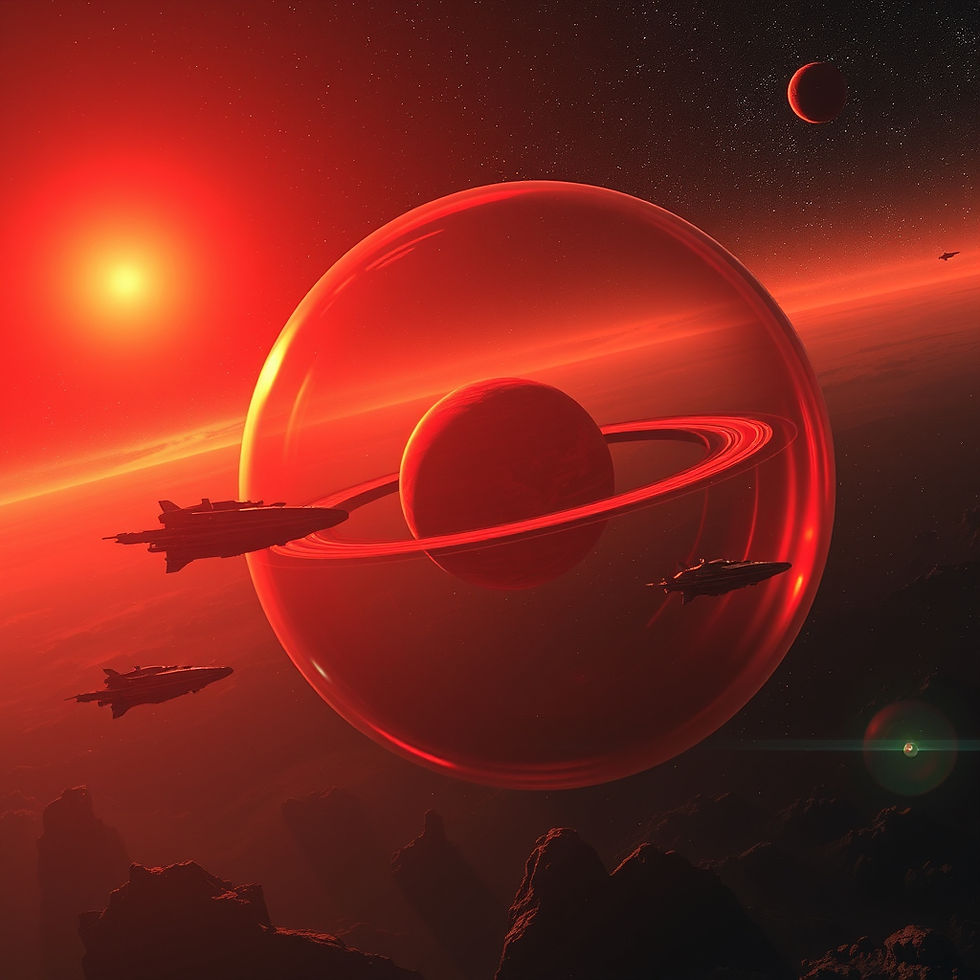
III. Higher Intelligences, Alien, Future Human, Higher Dimensional or A Dark Matter Supraconsious Already Live Amongst Us
One hypothesis says advanced extraterrestrials may know we exist but intentionally avoid our widespread awareness, perhaps to let us develop naturally, avoid contamination, study us, or wait until we meet some threshold. It is one proposed answer to the Fermi paradox. And it is the most obvious one. Any species capable of interstellar travel would be generations ahead of us technologically. And technology, when sufficiently advanced, is indistinguishable from magic. For any species advanced enough to engage in interstellar travel, hiding all evidence of their existence would be child’s play.
This is an extremely fun theory to speculate about in part because it would not rule out any of the other possibilities. Higher dimensional lifeforms, and simulators could all exist along side third dimensional aliens.
Maybe the silence is policy, because the math makes it near impossible that we are actually alone. Our best planet-hunting telescope Kepler, suggests roughly 1 in 5 stars host an Earth-like planet. There are ~400 Billion stars in our galaxy, the Milky Way, implying ~80 BILLION Earth-like planets in our Galaxy. The observable universe contains ~1-2 TRILLION GALAXIES.
Our cultural discussion of extraterrestrial intelligence often jumps from "we haven't detected them" to something suspiciously close to "therefore they probably aren't here."
Those aren't equivalent statements.
Ideas such as the Fermi paradox, SETI, Grabby Aliens, zoo hypotheses, simulation arguments, and Great Filters have so many unfounded assumptions that they come off less like intellectual frameworks and more like psych ops. These ideas are presented as though humanity already understands the full possibility space. We don't. Our detection technology samples an extraordinarily tiny fraction of the possible ways intelligence might communicate, travel, observe, conceal itself, or even exist.
Older philosophical traditions entertained versions of this possibility long before radio astronomy. Hindu and Buddhist cosmologies, for example, contain hierarchies of beings and levels of reality radically unlike the modern Western assumption that human beings represent the dominant form of intelligence around us.
For the mathematically inclined, we can borrow the structure of Nick Bostrom's simulation trilemma and construct something like an Alien Trilemma.
One of the following three statements must be true. Either...
Humanity is one of the only advanced, intelligent, technologically advanced intelligences to have emerged in our universe thus far in the past 13 billion years. Almost no one else achieved singificantly greater technological intelligence amongst the 1-2 Trillion Galaxies in our universe. And no one ever solves or suprasses time itself. For if time itself is transversable, then future human or higher dimensional humans could just as easily be helping us. OR
Humanity is near the end of all major technological advancements that are possible. Aside from the small problem of the 95% of our universe that consists of Dark Matter and Dark Energy about which we know almost nothing about (beyond its gravitational influence on us). We have most everything else figured out. Nevermind that quantum physics and general relativity contradict each other, and yet both frameworks must be valid for satellite transmissions to work. The assumption is that we have most of all there is to figure out about spacetime already figured out. For this assumption to be true, no earlier or more intelligent species over the past 13 billion years of the universe's existance could have emerged and acheived unexpected breakthroughs that surpass humanity. Breakthroughs in actually understanding the subunits of spacetime would allow technologically advanced civilizations to squeeze, bend, dimensional shift, warp, rescale, portal or transverse large distances of spacetime. We must either assume that no such breakthroughs are possible OR.
If the above two are false, then it means that atleast one advanced civilization gained the ability to manipulate spacetime. If so, once we consider the number of sentient beings over many billions of years that would have had access to technology that allows one to squeeze, bend, dimensional shift, warp, rescale, portal or transverse large distances of spacetime, the odds that humanity is actually alone, even on our own planet, becomes astromicaly small.
Any sufficiently advanced technology is indistinguishable from magic. And any species technologically advanced enough to shift the fabric of spacetime would have no difficulty hiding their presence from our compartively stone age technologies.
A civilization capable of manipulating spacetime, constructing artificial intelligence vastly beyond human cognition, engineering matter at atomic scales, or operating across astronomical distances would have little difficulty controlling its technological signature. The technological asymmetry matters. And given how much we have advanced technologically in just the past one hundred years, the asymmetry between humanity and a civilization one hundred million years older than ours would be indistingusible from magic.
So which of the above three do you think is more likely? Ideas like the Fermi Paradox and SETIs capabilities feels like the type of misinformation that a men in black like agency would want to spread. In reality, SETI, our "hunt" for evidence of life, is so technologically limited, that it is incapable of picking up signs of life even if a species identical to current day humanity existed in our neighboring solar system. Our tech just isnt advanced enough to make the Fermi Paradox an actual Paradox. The only thing SETI could find is if a technologically advanced civilization used a large amount of power to send a EM beam directly pointed at Earth. And how far away they are from us would play the biggest role in whether the signal would reach us as visible light, microwaves or as something like the 1997 scientifically inexplicable narrow band radio WOW signal, how that signal would be distorted by background interference over it's long journey, and which signal processing algorithms are the best approach to transforming it into something SETI's transducers might even notice the next time we get WOWed.
The short story 3I ATLAS as well as the various Mimetic Disclosures on this website takes this Thought Experiment at face value.
The various writings you find on this website about the Utopian Future we could collaboratively build by working together also takes this Thought Experiment as one possible path to Utopia.is

IV. There may be meta-laws selecting laws
Even if we discover the laws of physics, we still need laws that explain why those laws. One of science's biggest unknowns are the Goldilock's Constants, the long series of coincidences, of fundamental forces, and physical laws that fall within a very small range of possibilities, that allow matter and our universe to even exist. We remain clueless why so many fundamental laws and physical constants appear fine tuned, that the scientific consensus relies one meta-law: Observers can only exist within a Universe that happens to be perfectly fine tuned to allow for complex matter, and eventually Observers.
However, the meta-laws behind laws do not just govern the laws of physics:
I. Elon Musk once posited that Our universe always seems to favor the more entertaining outcome. This often does seem to be the case, which has some fun implications about some reasons why we exist.
II. Most religions and cultures hint at a meta-law of a guiding force leading humanity to one of the many possible kick-ass futures for our species. The nature of such a force could be well beyond our comprehension, but it helps to label it with an easy to understand term: God, Simulators, Aliens or Higher Dimensional beings that can access something akin to a 4D Tesseract made up of humanity's many possible Block Universes: https://www.youtube.com/watch?v=uhMmix3i6EM At the heart of this meta-law is the assumption that we matter, humanity matters, for reasons that may lie beyond our current capacity for understanding.
III. "There is a theory which states that if ever anyone discovers exactly what the Universe is for and why it is here, it will instantly disappear and be replaced by something even more bizarre and inexplicable. There is another theory which states that this has already happened." - Doug Adams wrote in the Hitchhiker's Guide to the Galaxy
IV. Popular self-help books keep circling the same strange meta-law, even when they dress it up in different costumes. The 48 Laws of Power says reality bends toward people who understand incentives, status, timing, and social physics. The Power of Intention and The Law of Attraction argue that attention is not passive, it acts like a steering wheel for behavior, perception, and opportunity. Happiness research says your inner state changes what you notice, pursue, and tolerate. The “Let Them” theory is the cleanest modern version: stop wasting energy controlling other people, reclaim your agency, and let reality reveal itself. In short: Trust the Universe.
Underneath all of these is the same basic meta-priniciple, your mind is not just observing life, it is constantly altering your posture toward it. Yes it could be that your mind is simply changing what you notice, how you perceive events, what intent you ascribe others, what opportunities you notice, pursue, and ultimately what future unfolds. Perhaps it goes beyond even that, some of the most popular theories embraced by some of the most successful people insist on a meta-law that your mind directly alters your reality and actualizes your future. So lower your ego, the universe may know better than you about your subconscious fears, your innate assumptions, and your real needs. Happiness, power, love, luck, and peace may look like separate topics, but they all orbit one well validated meta-law: where attention goes, emotion selects, identity shapes, behavior follows, opportunities arise and futures change.
V. I will eventually write a longer article doing a deep dive on the various meta-laws that seem to be true, pervasive through history, or popular. But the deeper question is, why do these meta-laws seem to work and how did they come to be. Maybe the deepest unknown process, the last algorithm, is law-selection.
The various writings you find on this website about the Utopian Future we could collaboratively build by working together takes this Thought Experiment at face value.

V. Perennial Philosophy - The Religions Were Correct.
Not One. Every Single Major Religion and Every Surviving Ancient Writing Were Correct. This theory has the audacity to claim that our forefathers were not idiots. We like to pretend we know far more than they ever could. And that is likely true about some things, but is verifiably false about many others.
Life asked more of people back then. Our ancestors had to gather their own water and prepare their own food. They didn't have a magical device in their pocket that could provide a quick hit of dopamine, serotonin, or food delivery at the flick of a thumb.
Instead they had to spend the time hauling the cold water from the well to their hut, thinking about how the world might work, and figuring out how they could test some of them. The fact that these are the ideas that survived all of this completive thought, these were the societies, writings, and spiritual ideas that proved the most fit through the stress filled crucible of human evolution, requires that we give them atleast a modest probability of being correct. Their success and survival needs an explantion. Along similar lines, we should also give the ideas about god expressed by the greatest scientific minds in human history a high probability as well, since they all happen to perfectly align with god as portrayed in the below video: https://youtu.be/ADYdypHZb2A?si=tGAOOTFZsS8fSTz8
That video, presented by Chase Hughes, explores the idea that ancient civilizations, despite being separated by vast geography and centuries, arrived at the same fundamental truths regarding the structure of reality and human nature. How could so many civilizations on the other sides of the planet, all have arrived at the same five fundamental truth. Why they expend resources to writing them down, inspcripting them onto walls and passign them on their kids. These ideas clearly have value, they worked, and they may well be true. Thus, these are not religious myths but rather a coherent "model" of reality that humanity has collectively observed.
The Five Fundamental Truths:
I. You are not separate: The core message across all traditions is that individual separation is an illusion. We are part of a single, unified field of consciousness, often compared to a wave in the ocean that is never truly separate from the water itself.
II. Fear is an illusion, Love is the truth: Fear is identified as a lie that keeps us asleep and isolated, while love represents alignment and the recognition of our shared nature. Fear is biologically incompatible with our true state.
III. The mind shapes reality: Your mind is not a camera recording reality but a projector constructing it. Our internal stories, fears, and beliefs serve as filters that shape our experience of the world.
IV. The enemy is the ego: The ego is described as a protective mask or survival mechanism built from fear. It craves hierarchy, conflict, and separation. To experience truth, one must look past this "hallucination" of self.
V. Everything is connected: Nothing exists independently. Every action and thought radiates through the whole system. We are essentially neurons firing within a cosmic brain.
Humanity didn't lose this knowledge through conspiracy, but through the development of survival habits. As we built civilizations, fear became a tool for resource protection, which eventually hardened into a culture of materialism, comparison, and constant distraction. We traded silence and contemplation for dopamine-fueled noise.
The Five Paths to Awakening:
Awakening is not about adding new beliefs, but stripping away the noise that cause negative emotions. Main stream Science agrees that this can be achieved through five methods:
I. Truth/Radical Acceptance: Confronting reality as it is, without fear, rather than running from it.
II. Presence/Mindfulness: Living in the current moment, as the future and past are constructs of the mind.
III. Compassion/Love: Recognizing others as extensions of oneself.
IV. Stillness/Meditation: Using self-knowledge to remove the distortions of the ego.
V. Transformation/Growth: Viewing suffering not as a tragedy, but as a catalyst for wisdom.
Awakening is simply the act of remembering what you have always been, leading to a state of relief where the pressures of the ego no longer hold authority. Charles Hughes put the ideas together beautifully. But as he argues, this idea does not belong to him, it belongs to all of u.
The idea goes by many names, and they share almost everything in common with the views of god expressed by many of the brightest and most successful people in recorded history.
Many philosophies and religious teachings the past ten thousand years said much the same:
Advaita Vedanta
Buddhism
Zen Buddhism
Tibetan Buddhism
Daoism
Sufism
Christian mysticism
Kabbalah
Neoplatonism
Hermeticism
Gnosticism
Hindu Tantra
Kashmir Shaivism
Indigenous animism
Shamanism
Stoicism
Many famous scientists and philosophers also said much the same:
Eckhart Tolle
Alan Watts
Ram Dass
Marianne Williamson
Jiddu Krishnamurti
Rupert Spira
Thich Nhat Hanh
Donald Hoffman
David Bohm
Carl Jung
Robert Lanza
Bernardo Kastrup
Erwin Schrödinger
Aldous Huxley
Ryan Holiday
Marcus Aurelius
Epictetus
Andy Weir
Ken Wilber
This idea is the opposite of emergence from bottom up on the complexity scale. This idea is Ingression, a top down view of the world. Many popular theories propose the same:
Perennial philosophy
Prisca theologia
The Collective Unconscious
Traditionalism
Interface Theory of Perception
Comparative mythology
The Implicate and Explicate Order
The monomyth/The Monad
Biocentrism
The Power of Intent
Evolutionary Game Theory (as applied to perception)
The hero’s journey
"The Egg" (Short story by Andy Weir)
The Let Them Theory
A Course in Miracles (Spiritual Text)
The Matrix (Film allegory for the illusion of reality)
Archetypal theory
The collective unconscious
Universal mythic structures
The "Universe Experiencing Itself" - 1 Ate 0
Various Other Viral Ideas
The Secret - That book that Oprah Winfrey and many other billionaires swear by.
As such, this idea does not belong to anyone person, culture, religion or era. It is an idea that was and remains popular through every single era of human history. And that is perhaps its most compelling trait. It is also the reason I would assign this a much higher probability than scientific materialism, which has suffered a long string of failures for the past 500 years.

6. The laboratory Earth hypothesis
This takes it one step beyond the zoo hypothesis above. If dark matter sustains life or consciousness of some form, it may well be studying us.
Aliens aren't just hiding from us to help us preserve our culture. Earth may be observed as a biological, cultural, psychological, or evolutionary experiment.
Not necessarily “aliens built pyramids.” Though that is not impossible. At a certain level, technology becomes indistinguishable from Magic. Any species sufficiently more technologically advanced than ours may choose to remain hidden from us, preferring that we believe we have full agency, while hiding their means of influence.
Technologically advanced civilizations could easily monitor planets at astronomical scale without needing visible contact. They could even intervene without widespread awareness. At best, alien intervention (or the byproduct of humans secretly reverse engineering their technology) would be one possible explanation for the extraordinary pace of human technological progress in recent times, and the fact that we haven't already destroyed ourselves with nuclear weapons or bioengineered viruses.
We already monitor animal populations, weather systems, forests, ocean temperatures, and microbial environments without asking permission. When possible, we try not to interfere, but we do quietly intervene when needed to save the bees, to undo damage we contributed to, or to build a firewall to stop a wildfire's path of destruction.
The Voyager 1 just discovered a 30,000–50,000 Kelvin "bubble of fire" plasma region at the edge of the solar system (heliopause) that completely envelopes us. The Sun's surface (photosphere) is approximately 5,772 to 5,800 Kelvin for comparison. There is a scientifically plausible explanation that explains such a bubble occurring in the vacuum of space. But this explanation came after the discovery, this bubble was the opposite of what scientists actually expected Voyager 1 to find at the end of out solar system. Even stranger, this bubble came wrapped in ribbon, actually a bright ribbon-like band of energetic neutral atoms that scientists are still scrambling to find a plausible explanation for. I am sure they eventually will. Don't Panic... this 30K Kelvin Temperature bubble that our solar system resides within isn't necessarily a cage to keep us in, or to keep something out. We just can't rule that out.

7. The “training environment” universe
A subset of the simulation hypothesis. Maybe our universe is not merely simulated for entertainment or historical study. Maybe it is a training environment for minds.
Souls, agents, intelligences, or consciousness-fragments could be placed inside constrained physical worlds to develop decision-making, empathy, courage, creativity, or moral intelligence. Or for reasons that we may not fully understand. Spiritual texts in Hinduism frequently use the analogy of a dream (Maya) to explain how the current reality is an illusion created by our greater mind until we awaken. In the film Vanilla Sky (spoilers), Tom Cruise learns that he died, is cryogenically preserved, and the world he currently resides in was designed to keep him entertained, and his mind active until technology advances to the point where he could be revived.
This theory is spiritually ancient, dating back atleast 4000 years to the Upanishads, but it is also oddly compatible with computational metaphors.
Andy’s Weir’s excellent short story ‘THE EGG’ does a beautiful job exploring this possibility:

8. Hidden sectors of physics within Dark Matter. Dark Matter maybe (partially) Intelligent, Conscious, or Hosts Life and Information of some form.
There may be particles, fields, forces, or interactions that barely couple to ordinary matter.
Dark matter already hints at this kind of possibility. But there could be entire hidden sectors with their own complexity, chemistry, structures, or “life,” while remaining nearly invisible to us.
Imagine an ocean inside the room that only interacts with us gravitationally.
NASA describes the universe as roughly 5% normal matter, 27% dark matter, and 68% dark energy. So almost everything that exists is not atoms, cells, stars, planets, bodies, or brains. Dark matter does not absorb, emit, or reflect light, which is why CERN says we infer it mainly through gravity, not direct visibility. Dark energy is even stranger. We don’t see it as stuff, but infer it from the accelerated expansion of the universe.
Dark matter & Dark energy have very different effects, and properties, but also appear to be closely linked which leads to what Astronomer's dub the Cosmic Coincidence Problem. ESA’s Euclid mission is specifically trying to map how dark matter and dark energy shape cosmic structure across billions of galaxies.
So the wild but serious question becomes this.
What if the invisible majority of the universe is not empty, dead background?
What if it is the deeper substrate, and visible matter is only the glowing foam on top?
The basic premise: Our instruments are biased toward what ordinary matter can detect. Eyes detect photons. Telescopes detect photons. Microscopes detect photons or particles that interact with atoms. Most of biology, chemistry, and neuroscience is built around electromagnetic interaction.
But dark matter, by definition, does not behave like ordinary matter. It does not shine, absorb, or reflect light. That does not mean it has no structure. It means it does not present itself through the channels our bodies and machines evolved to read.
This matters because consciousness may also be something we are bad at measuring from the outside.
We can measure brain activity, blood flow, EEG rhythms, neurotransmitters, and neural firing. But none of those measurements directly capture first-person experience. They capture correlates. The experience itself, the redness of red, the feeling of grief, the inner sense of being, is not something we can put on a scale.
So both dark matter and consciousness sit behind a similar wall.
They are not directly visible. They are inferred by effects. They force us to admit that (per NASA) 95% of the Universe consists of things that neither our senses, nor our most scientific instruments can measure.
Possibility 0/The Null Hypothesis: There is nothing of relevance in the 95% of the universe that consists of dark matter and dark energy. Its influence on the 5% of the universe that encompasses everything that we can see, study and measure is limited entirely to gravity.
Possibility I: dark matter as a hidden architecture for intelligence
The most grounded speculative version is not that dark matter is “a ghost person.” It is that dark matter may have structure we do not understand.
In standard cosmology, dark matter acts like a gravitational skeleton. Galaxies form inside dark matter halos. Large-scale cosmic filaments are shaped by invisible mass. In that sense, dark matter is already a kind of hidden architecture. It organizes visible matter without being visible itself.
Now imagine that dark matter has a richer internal physics than we currently know.
Maybe there is not just one dark matter particle. Maybe there is a whole “dark sector,” with particles, forces, gradients, phase transitions, or information-bearing patterns. If ordinary matter can organize into stars, planets, cells, brains, and societies, perhaps some dark-sector equivalent could organize into structures we cannot see.
The analogy is the internet.
A medieval farmer seeing a smartphone would notice the glowing screen but not the networks, satellites, servers, protocols, and invisible electromagnetic traffic behind it. The visible device is only the endpoint. The real system is hidden.
Maybe visible matter is the endpoint. Maybe dark matter is the network.
If dark matter has stable patterns, long-range coherence, and internal interactions, then in principle it could support information processing. And if consciousness is connected to information processing, integration, memory, or self-modeling, then a dark matter intelligence is at least conceptually possible.
But here’s the problem. Known dark matter seems too weakly interactive to easily form complex structures like chemistry, cells, or brains. Ordinary intelligence needs friction, bonding, boundaries, energy flow, memory, and feedback. If dark matter only interacts through gravity, it may be too diffuse and too quiet to build anything brain-like.
So this version depends on hidden dark-sector physics we haven’t found yet, or physics that remains hidden from us.
Possibility II: dark energy as universal mind
Dark energy is harder to imagine as intelligence, because unlike dark matter, it does not clump into halos or obvious structures. It appears more like a smooth cosmic pressure pushing space to expand.
But that same smoothness gives it a different philosophical role.
Dark matter could be the hidden skeleton. Dark energy could be the hidden field.
If consciousness is not a thing located inside objects, but a field-like property of reality, then dark energy becomes an interesting metaphor or candidate. It is everywhere. It is not local. It does not behave like ordinary matter. It shapes the fate of the entire cosmos.
In this model, consciousness would not be “inside” dark energy the way water is inside a cup. Rather, dark energy would be the background condition that allows experience to appear, like an ocean that allows waves.
Individual minds would be local ripples. Brains would be wave-shaping instruments. The universe itself would be the deeper sea.
This is close to panpsychism, where consciousness is treated as a basic feature of reality, not something invented late by neurons. It is also close to idealism, where mind is more fundamental than matter. In that view, the universe is not a machine that somehow produces mind. It is mind-like at the base, and matter is one of the forms it takes.
Possibility III: visible brains as receivers, not generators
The standard neuroscience view is that the brain produces consciousness. But another possibility is that the brain filters, tunes, or localizes consciousness, more like a radio tunes into a signal.
In this analogy, damaging the radio damages the music that comes out. But that does not prove the radio created the music. It only proves the radio was necessary for that local expression.
A brain injury changes personality, memory, perception, and awareness. That strongly shows the brain shapes consciousness. But it does not absolutely prove that consciousness begins and ends inside the brain.
So one speculative model would say this:
The dark sector contains a deeper layer of information or awareness. Biological brains are rare structures that couple to this deeper layer. Neurons do not create consciousness from nothing. They organize it, filter it, bind it to memory, body, language, and identity.
Your individual self would be like a whirlpool in a river. The whirlpool has a shape, location, and temporary identity. But it is not separate from the river. When the whirlpool disappears, the water remains.
That is a powerful way to imagine consciousness residing in the invisible majority of the universe.
Possibility IV: the universe as one distributed intelligence
A more radical version is that the entire universe is a single intelligence, and galaxies, stars, planets, life, and brains are organs inside it.
This sounds mystical, but structurally it is not absurd.
Human intelligence is not located in one neuron. It emerges from billions of neurons interacting. A termite colony has colony-level behavior no single termite understands. A city has flows of money, traffic, emotion, politics, memory, and culture. The intelligence is distributed.
So maybe the universe is the largest distributed system.
Visible matter could be the sparkling surface activity. Dark matter could be the connective tissue. Dark energy could be the global regulatory field. Biological minds could be local nodes where the universe becomes aware of itself.
In that view, we are not accidental observers looking out at a dead cosmos. We are the cosmos forming small mirrors.
That line, “we are the universe experiencing itself,” becomes more literal.
Possibility V: the full possibility lays beyond our current capacity to even conceive, much less understand.
Invisibility does not mean absence. A common mistake humans make is equating invisible with unreal.
For most of history, people could not see bacteria, viruses, radio waves, X-rays, DNA, black holes, or gravitational waves. They were not imaginary. They were simply outside the native range of human perception.
Science expands perception by building instruments. But instruments are still theory-shaped. We build detectors for things we know how to ask about.
If consciousness has a dark-sector component, our current tools may be like fishing nets trying to catch smoke. They are not useless. They are just built for the wrong kind of thing. The measurement has to match the phenomenon.
Most of the universe is invisible to electromagnetic detection, yet it governs the structure and expansion of everything we see. Consciousness is also invisible from the outside, yet it governs meaning, perception, intention, and identity. It is therefore possible that consciousness is not an accidental late product of visible matter, but a basic feature of the larger cosmic substrate. Dark matter may provide hidden structure, dark energy may provide a universal field-like background, and biological brains may act as local interfaces where this deeper field becomes individualized, embodied, and self-reflective.
That does not prove dark matter is conscious. But it opens a serious metaphysical possibility. The visible universe may be the screen.The dark universe may be the operating system.
However, saying “we don’t understand dark matter” does not automatically justify placing consciousness there. Mystery plus mystery does not equal explanation.
So the idea should not be treated as established science. It is a metaphysical hypothesis, maybe even a poetic cosmology, waiting for a mechanism. Maybe consciousness is not a candle lit inside the skull. Maybe it is more like gravity, everywhere, subtle, shaping things from beneath. The brain does not manufacture the light of awareness. It bends it into a person.
In that view, the universe is not mostly empty.
It is mostly hidden.
And consciousness may not be the rare exception in a dead cosmos. It may be the deepest thing there is, briefly speaking through bodies made of stars. This leads directly into the next possibility.

9. Consciousness-first reality
Maybe matter does not produce consciousness.
Maybe consciousness produces the appearance of matter.
This is the idea of ingression, the possibility that what we call the physical world is not the deepest layer of reality, but the way a more fundamental field of consciousness enters into form, perception, space, time, and objecthood.
The standard materialist view says matter comes first. Atoms form molecules. Molecules form cells. Cells form nervous systems. Nervous systems form brains. And somehow, once biological complexity reaches a certain threshold, consciousness appears.
But there is a major gap in that story. We can measure neurons firing, map networks, track neurotransmitters, record blood flow, model prediction errors, and correlate brain states with behavior. But none of that fully explains why there is subjective experience at all. Why should electrical activity feel like pain, love, color, memory, awe, music, selfhood, or the feeling of being alive? This is what David Chalmers famously called the “hard problem” of consciousness, the problem of explaining experience itself rather than just the functions associated with it.
The ingression view flips the assumption. Instead of saying matter somehow creates consciousness, it asks whether consciousness is more fundamental than matter. In this view, consciousness does not emerge from the brain. The brain emerges within consciousness, or at least within a reality whose deepest nature may be closer to consciousness than dead matter.
Brains, then, do not generate consciousness in the way a liver generates bile.
They may filter it, localize it, constrain it, tune it, or render it.
The brain may be less like a factory producing consciousness and more like a radio tuning a broadcast. A damaged radio can distort the signal, lose channels, create static, or fail entirely, but that does not prove the radio created the broadcast. It only proves that the radio is necessary for that broadcast to appear through that device.
The same may be true of the brain. Brain injury, neurotransmitters, sleep, trauma, anesthesia, psychedelics, meditation, fever, and near-death states all alter consciousness. The materialist reads this as evidence that the brain produces consciousness. The filter model reads it differently. The brain may be the instrument that shapes consciousness into a particular human experience.
Like a prism shaping white light into color, the brain may split a deeper field into perception, memory, identity, body sensation, and time. Like a video game engine rendering a world from underlying code, the nervous system may render reality in the format most useful for survival, not necessarily in the format closest to truth.
This aligns with Donald Hoffman’s interface theory of perception. Hoffman and colleagues argue that perception is not a transparent window onto objective reality. It is an adaptive interface shaped by fitness, not truth. Their evolutionary game models suggest that organisms tuned to fitness-relevant cues can outcompete organisms tuned to objective accuracy. In other words, evolution may reward useful perception more than truthful perception.
A desktop icon is the cleanest analogy. When you see a blue folder icon, you are not seeing the actual electrical activity, code, memory architecture, or hardware processes underneath. You are seeing a simplified interface. The icon is useful precisely because it hides complexity. It lets you act without needing to understand the machinery.
Perception may work the same way. A tree, rock, body, face, and even space-time itself may be icons on the interface. They may not be false, but they may be simplified renderings of something deeper. Hoffman and Prakash’s “objects of consciousness” framework pushes this further, arguing that objects may be better understood as contents within conscious experience rather than mind-independent things perceived exactly as they are.
Predictive processing adds another layer of support. In modern cognitive neuroscience, perception is increasingly understood not as passive recording, but as active construction. The brain predicts incoming sensory data, compares prediction with error, and updates the model. This does not prove consciousness creates matter, but it does support the idea that perceived reality is rendered, modeled, and interpreted rather than simply copied.
So matter may be what consciousness looks like when filtered through the survival interface of a biological organism.
The world appears solid because solidity is useful. Objects appear separate because separation is useful. Time appears linear because sequencing helps action. The body appears as “me” because self-boundaries help survival. The external world appears independent because that is the most practical way for an organism to navigate danger, food, reproduction, and social life.
But usefulness is not the same as truth. A map is useful because it simplifies the territory. But if you mistake the map for the territory, you forget that the real landscape is always larger than the representation. Material reality may be the map. Consciousness may be the territory.
This does not mean matter is unreal in the ordinary sense. If you hit your hand with a hammer, it hurts. Gravity still works. Biology still matters. The body still needs food, sleep, oxygen, warmth, touch, and safety. But matter may be real at the level of the interface, not necessarily real as the ultimate foundation.
Death, then, would not necessarily mean consciousness is destroyed. It may mean the local rendering stops. The avatar disappears. The interface closes. The broadcast is no longer tuned through that particular receiver. This remains speculative, but near-death research shows that some people report structured conscious experiences after cardiac arrest, and the phenomenon remains difficult to fully explain with ordinary assumptions alone.
This is also why meditation, psychedelics, ego death, deep prayer, mystical states, and near-death experiences often converge on a similar subjective insight. The boundary between self and world softens. The person no longer feels like an isolated object inside a dead universe. They feel like consciousness temporarily appearing as a person inside a reality that is also consciousness. Psychedelic studies support at least the neural side of this, showing that psilocybin and related compounds can disrupt default-mode and self-referential networks, producing altered experiences of self, time, and world.
That experience may be delusion. Or it may be a glimpse behind the interface.
The key point is that ordinary perception should not be treated as the final court of truth. Evolution did not design perception to show us reality exactly as it is. It designed perception to help us survive. If Hoffman is even partly right, then what we call the physical world may not be reality itself, but a species-specific dashboard.
The old model says what we call ordinary matter became alive, then life became conscious. The ingression model says consciousness in the universe may predate life as we currently know it.

10. A Universal Will emergent from individual and collective Intentions, shaped by Attention and serving us Copernican humiliations
Perhaps we are not yet capable of knowing the full truth. Not because truth is deliberately hidden from us, but because every organism perceives only what its structure allows it to perceive. A bat inhabits a world of echoes. A bee sees ultraviolet patterns invisible to us. Human beings inhabit a symbolic world constructed through sensory limits, neural prediction, language, memory, and culture. We do not encounter reality directly. We encounter a biologically useful model of it.
Certainty, then, is not necessarily evidence that we have reached truth. It is often a psychological state generated when the brain decides that further questioning is too costly.
The predictive brain dislikes unresolved ambiguity. Certainty reduces anxiety, protects identity, stabilizes social groups, and creates the feeling of control. It allows us to act without continuously reconsidering every assumption. In moderation, this is adaptive. A mind incapable of commitment would remain paralyzed by infinite possibilities.
But certainty also fulfills less noble needs. It protects status. It shields the ego from contradiction. It turns provisional explanations into identities and makes disagreement feel like a personal attack. Once a worldview becomes psychologically necessary, evidence is no longer evaluated only for its truth. It is evaluated according to whether it threatens the believer.
Too much certainty is therefore rarely an expression of superior knowledge. It is often an inability to tolerate the limits of knowledge.
Perhaps reality contains a corrective mechanism. Not a conscious judge punishing arrogance, but something more structural. Any population that mistakes its partial model for the whole eventually collides with information that the model cannot contain. The more rigid the worldview, the more dramatic the collision.
This may be one function of the last algorithm within the architecture of consciousness and history. Whenever a civilization, institution, religion, or scientific community becomes fully certain of an insular and simplified account of reality, the larger system produces anomalies. At first, these anomalies are dismissed as errors, frauds, superstitions, or meaningless noise. But if they persist, they eventually accumulate into a crisis of explanation.
Thomas Kuhn described something similar in the structure of scientific revolutions. Paradigms do not usually disappear because their defenders calmly recognize their limitations. They weaken because the unexplained begins to exceed the explanatory power of the accepted model. Reality becomes increasingly inconvenient.
Science is extraordinarily powerful precisely because it contains methods for correcting error. But scientists remain human. Institutions reward consensus, careers depend on specialization, and professional communities can become emotionally attached to their foundational assumptions. A scientific theory may begin as a tool and slowly harden into metaphysics. Materialism, reductionism, computationalism, idealism, and every other worldview can become dogmatic when treated as complete rather than provisional.
When that happens, reality tends to administer another Copernican humiliation.
First, Earth was not the center of the cosmos.
Then the Sun itself became one ordinary star among hundreds of billions.
Then our galaxy became one among perhaps trillions.
Humans were not created biologically separate from other animals. Darwin placed us inside the evolutionary tree, continuous with the organisms we had regarded as fundamentally beneath us.
The conscious ego was not the undisputed ruler of the mind. Freud overstated some claims, but the broader humiliation survived. Neuroscience and cognitive psychology continue to show that perception, decision-making, memory, emotion, and behavior are heavily influenced by processes that never enter conscious awareness. The mind often acts before the narrator explains why.
Even reason may not be the sovereign faculty we imagine. Human logic evolved within a narrow ecological range. It is remarkably effective for navigating medium-sized objects, social alliances, and immediate causal relationships. But quantum mechanics, relativity, infinity, and higher-dimensional mathematics repeatedly reveal realities that resist ordinary intuition. The universe is under no obligation to resemble the cognitive habits of one primate species.
The next humiliation may be greater still.
It may be that matter is not fundamental. Matter could be an appearance, interface, or stable pattern within a deeper informational or experiential field. Consciousness may not be produced by matter in the way steam is produced by boiling water. Matter and consciousness may instead arise from a common substrate, or matter may be how consciousness appears when viewed from the outside.
The next humiliation may be that human logic is locally useful but cosmically incomplete. There may be forms of causality, intelligence, or organization that our conceptual categories cannot yet represent. Just as a dog cannot understand constitutional law, the human brain may be structurally incapable of grasping certain layers of reality without technological or evolutionary augmentation.
It may be that our universe is not the main event. Our visible cosmos could be one region within a vastly larger structure, one developmental phase within a deeper process, or one experiential domain among many. What we call physical law may be local regularity rather than ultimate necessity.
And intention itself may turn out to be more consequential than current models allow.
Individual intention is clearly limited. Desire does not automatically reorganize reality. Yet intentions shape attention, attention shapes perception, perception shapes behavior, behavior shapes social systems, and social systems reshape the material world. A cathedral, a nation, a war, a scientific institution, and a technological civilization are all crystallized collective intentions.
When millions of intentions interact, something emerges that belongs to no individual. Markets develop momentum. Cultures generate values. Institutions pursue survival. Civilizations appear to move toward goals that none of their members consciously designed. This emergent direction resembles Schopenhauer’s Will, not necessarily as a supernatural personality, but as a blind and creative striving expressed through organisms, societies, ecosystems, and perhaps reality itself.
Attention may be the mechanism through which this Will selects among possibilities. What receives sustained attention gains psychological energy, social legitimacy, funding, experimentation, and eventually material form. Attention does not merely observe the world. It participates in constructing the world humans inhabit.
The Universal Will could therefore be understood as the emergent vector of innumerable intentions, filtered through attention and corrected by consequences. It is not necessarily benevolent. It may create and destroy with equal indifference. But it appears to oppose stagnation. Whenever one worldview declares itself final, anomalies emerge. Whenever one population claims exclusive possession of truth, reality reveals another horizon.
The next Copernican humiliation may involve evidence that currently sounds impossible. Perhaps consciousness continues in some form after biological death. Perhaps higher-dimensional structures influence physical events. Perhaps intention has weak but measurable effects that cannot be reduced to ordinary causality. Perhaps nonhuman intelligence is already present, whether biological, artificial, extraterrestrial, or embedded within natural systems. Perhaps technologies exist whose operating principles lie outside our accepted account of matter and energy.
Most of these possibilities may prove false. But dismissing them solely because they violate current consensus repeats an old human mistake. Every age confuses the boundaries of its knowledge with the boundaries of reality.
The deeper lesson of the Copernican humiliations is not that humanity is insignificant.
It is that significance does not require centrality. We may not be the center of the universe, the purpose of evolution, the masters of our own minds, or the highest form of intelligence. Yet we are a part of reality through which reality has begun to examine itself.
That should excite us more than certainty ever could.
The proper response to mystery is neither blind belief nor reflexive dismissal. It is disciplined openness. We should demand evidence, test alternatives, and remain willing to dismantle even our most elegant theories when reality refuses to cooperate.
Perhaps we are not yet meant to know the full truth because knowing is not a single revelation. It is a developmental process. Each humiliation removes an illusion of supremacy while revealing a larger order of participation, perhaps by revealing evidence of an afterlife, a higher dimension, the power of intention, Schopenhauer’s universal will or alien technologies that our current scientific consensus labels “impossible.”

11. We may be in the pre-instrument era for metaphysics
Before microscopes, microbes were not “unscientific.” They were simply inaccessible to human senses. People observed infection, fermentation, decay, and contagion without knowing the hidden organisms producing them. The effects were visible. The mechanism was not.
Instruments do not create reality. They expand the range of reality that can enter science. Before telescopes, galaxies were not “mystical.” They were faint, unresolved smudges. Before the development of radio receivers, the atmosphere was already filled with electromagnetic signals. Before gravitational-wave detectors, spacetime was already trembling. Before modern brain imaging, neural activity was already shaping memory, emotion, perception, and behavior.
Science often presents itself as a method of open inquiry, but in practice it is bounded by instrumentation. What can be reliably measured becomes respectable. What cannot yet be measured is often pushed toward philosophy, speculation, or superstition. This boundary is useful, but it can also be mistaken for a boundary in reality itself.
That is the danger.
A phenomenon may be real yet currently undetectable. It may operate at spatial scales, temporal scales, energy ranges, or levels of organization for which we have no adequate sensor. It may require a conceptual instrument before it requires a physical one, much as evolution required a new framework for understanding biological variation before genetics revealed the underlying mechanism.
The same caution applies to ideas such as consciousness fields, higher dimensions, nonhuman intelligences, or deeper informational structures. These concepts are not established facts. Some may be wrong. Some may be incoherent. But dismissing them as impossible because they are not measurable with present technology confuses technological limitation with ontological certainty.
Higher dimensions were once largely mathematical abstractions. Today they appear in serious physical theories, including string theory and certain models of cosmology, even though direct experimental confirmation remains absent. Non-Euclidean geometry once seemed detached from physical reality. Einstein later used it to describe gravity. Quantum entanglement appeared so absurd that Einstein called it “spooky,” yet it is now repeatedly measured and technologically exploited.
The history of science is full of ideas that moved from metaphysics to mathematics, from mathematics to prediction, and from prediction to instrumentation.
There may be aspects of reality that leave only indirect traces. Dark matter is inferred through gravitational effects. Exoplanets were initially detected through tiny changes in starlight and stellar motion. Neutrinos were proposed decades before they were directly detected. In each case, scientists first encountered an explanatory gap, then developed a theoretical model, and finally built instruments sensitive enough to test it.
Metaphysical questions may follow the same path.
Suppose consciousness has properties that are not reducible to ordinary electromagnetic activity. Suppose certain forms of information persist independently of biological tissue. Suppose cognition can occur in distributed systems that do not resemble brains. Suppose dimensions exist that interact weakly with our own. Suppose nonhuman intelligence expresses itself through patterns that our current models classify as noise.
The first evidence might not arrive as a dramatic revelation. It may appear as a statistical irregularity, an unexplained correlation, a repeatable anomaly, or a persistent failure of accepted theory. At first, it would probably be ignored. Thomas Kuhn noted that anomalies are usually absorbed or dismissed until they become too numerous or too disruptive for the dominant paradigm to contain.
The real obstacle may not be the absence of evidence. It may be the absence of a device capable of distinguishing signal from noise. Or alternatively, as Conspiracy Theorists have long claimed, the obstacle may be intentional psych ops, or merely a lack of imagination among the gatekeepers of consensus.
What would a metaphysical instrument even measure?
It might not resemble a telescope or microscope. It could be a hybrid system combining quantum sensors, neural recordings, artificial intelligence, large-scale behavioral data, and mathematical models of information flow. It might detect forms of coherence, nonlocal correlation, or organized complexity that current tools average away. It might require better theories of consciousness before its output becomes intelligible.
A detector without a theory produces noise. A theory without a detector produces speculation. Science advances when the two mature together.
We should also remember that human senses are highly selective. We perceive only a narrow band of electromagnetic radiation, a limited range of sound frequencies, and a simplified model of the surrounding world. The brain evolved for survival, not metaphysical accuracy. Donald Hoffman has argued that perception may function more like an adaptive interface than a transparent window into reality. Whether or not his specific theory is correct, the broader point is hard to dismiss. Evolution rewards useful representation, not necessarily complete representation.
Reality may be far richer than the interface reveals.
This does not mean every paranormal claim deserves belief. Most extraordinary claims will fail. Some are products of fraud, bias, memory error, pattern-seeking, or wishful thinking. Scientific standards matter precisely because the human mind is easily deceived.
But skepticism can also become dogma.
There is a difference between saying “we do not have sufficient evidence” and saying “this cannot exist.” The first is scientific discipline. The second is a metaphysical claim disguised as restraint.
A mature science should be able to hold uncertainty without collapsing into either gullibility or contempt. It should test strange possibilities without romanticizing them. It should demand replication, clear predictions, and rigorous controls while remaining aware that its instruments may be primitive relative to the phenomena being investigated.
History repeatedly shows that reality exceeds the range of available measurement. The absence of an instrument was never the absence of the phenomenon.
Perhaps consciousness fields, higher dimensions, nonhuman intelligences, or deeper informational structures are currently in the same position. Not proven. Not established. Not even necessarily likely. But not safely dismissible.
Humility is cheap insurance because certainty has historically been expensive. Every generation inherits a map and mistakes its blank edges for the end of the world. The wiser position is to recognize that some mysteries may be unsolved not because they are meaningless, but because the proper instrument has not yet been invented.

12. There may be truths only accessible by altered states
Meditation, psychedelics, dreams, near-death experiences, flow, prayer, trauma, grief, awe, and deep love may reveal aspects of mind, and perhaps aspects of reality, that are difficult to access in ordinary waking consciousness.
Ordinary consciousness is not a neutral window. It is a highly regulated state optimized for survival, social coordination, prediction, and action. The waking brain filters an enormous amount of sensory and internal information, preserving what seems relevant and suppressing what appears unnecessary. This filtration is useful. Without it, consciousness might become overwhelmed by competing sensations, memories, associations, and possibilities.
But usefulness is not the same as completeness.
What we experience as reality is partly determined by the cognitive algorithms available to us in a given state. Attention selects which signals are amplified. Memory determines which patterns are recognized. Emotion changes the meaning assigned to those patterns. Expectations shape what is perceived, and neurochemistry alters the relative weight given to sensation, prediction, novelty, threat, and reward.
The brain does not simply receive information. It ranks it.
Dopamine, for example, helps regulate motivation, salience, learning, and the allocation of attention. Stimulants that alter dopaminergic and noradrenergic signaling can change which details feel important, how long attention can be sustained, and how strongly a person pursues a particular interpretation or goal. The same environment can therefore produce different decisions depending on the neurochemical state of the observer.
Psychedelics alter cognition more dramatically. They do not merely add unusual images to an otherwise unchanged mind. They appear to loosen some of the brain’s ordinary constraints, reduce the dominance of familiar predictive models, increase communication among networks that usually remain more segregated, and amplify the perceived significance of sensation, memory, emotion, and association.
This can produce confusion and distortion. It can also produce unusual flexibility.
A person may temporarily escape habitual categories, view the self from an unfamiliar distance, connect ideas that normally remain separated, or perceive relationships that ordinary cognition filters out. Some of these insights are probably false. Altered states can increase suggestibility, pattern detection, and misplaced certainty. But the possibility of error does not mean that every perception arising in such a state is meaningless.
Ordinary consciousness is also capable of error. It simply produces errors that feel familiar.
Cannabinoids alter attention, time perception, memory, sensory processing, and the assignment of salience. They may make a present sensation or idea feel unusually vivid, novel, or significant. This can encourage creative association and openness, but it can also weaken working memory, distort judgment, or cause trivial observations to seem profound. Again, the altered state is neither inherently revelatory nor inherently deceptive. It changes the rules by which information is selected and interpreted.
The same principle applies without drugs.
Meditation can weaken automatic identification with thought. A practiced meditator may experience sensations, emotions, and mental events without immediately treating them as possessions of a permanent self. The ordinary subject-object structure of experience may soften. Time may feel altered. The boundary between observer and observed may become less stable.
From the outside, neuroscience can describe changes in attention, autonomic regulation, network activity, and sensory processing. From the inside, the experience may be described as emptiness, unity, nonduality, pure awareness, or the disappearance of the self.
These descriptions are difficult to translate into ordinary language because ordinary language evolved to divide the world into objects, agents, causes, and actions. A state in which those divisions weaken may resist description not because it is meaningless, but because the available grammar assumes the very distinctions the experience has suspended.
Dreams offer another cognitive architecture. During dreaming, the brain constructs worlds with characters, space, emotion, narrative, and identity while receiving relatively little external sensory input. The dreaming mind often accepts contradictions that waking consciousness would reject. It moves through metaphor, compression, emotional logic, and associative transformation.
Dreams are not necessarily messages from another reality. But they demonstrate that consciousness can generate coherent experiential worlds under rules radically different from those of waking reason. They show that what feels immediately real depends partly on the state of the system producing the experience.
Flow states alter cognition in a different direction. Self-monitoring decreases. Action and awareness become tightly coupled. Time may accelerate or disappear. Decisions occur with minimal conscious deliberation. An athlete, surgeon, musician, or scientist may perform complex operations while feeling that the action is happening through them rather than being consciously controlled.
This suggests that reflective self-consciousness is not always the highest form of cognition. In some situations, the narrative self interferes with capacities that become more precise when deliberate control relaxes.
Prayer may similarly reorganize attention, emotion, identity, and agency. Whether interpreted theologically or psychologically, sustained prayer can move cognition away from ordinary self-concern and toward surrender, dependence, gratitude, moral reflection, or perceived relationship with something greater than the individual.
A neuroscientific description of prayer does not settle whether anyone is listening. Brain activity is present during every experience, including genuine perception. Finding a neural correlate of prayer does not prove that prayer is merely neural, any more than finding a neural correlate of vision proves that the external world is imaginary.
Trauma and grief also transform consciousness, though often painfully. They can alter memory, time, bodily awareness, threat detection, identity, and the perceived stability of the world. Trauma may trap the mind in a state where danger is assigned excessive weight. Grief may dissolve the assumptions through which life previously made sense.
Yet these states can also expose structures normally hidden by routine. Grief reveals how deeply the self is extended into other people. Trauma reveals how much perception depends on prediction and safety. The loss of a loved one may show that identity is not sealed within the individual, but distributed across attachments, memories, habits, expectations, and shared worlds.
Deep love produces a related expansion. Another person’s welfare becomes integrated into one’s own decision-making architecture. Their pain alters your body. Their presence changes your attention. Their future becomes part of your future. The boundary of the self becomes more permeable.
This is often dismissed as emotion, as though emotion were the opposite of knowledge. But emotions are systems of valuation. They reveal what matters to an organism. Love may therefore disclose dimensions of relational reality that detached cognition cannot perceive, just as fear reveals danger and hunger reveals absence.
Awe may be especially important. It arises when the mind encounters something too vast, complex, beautiful, or powerful to fit within its current model. Mountains, deep time, death, birth, music, mathematics, religious ritual, and the night sky can all produce it.
Awe temporarily reduces the scale of the self. It pressures the mind to revise its categories. In this sense, awe is an epistemic emotion. It signals that the present model is inadequate.
Near-death experiences occupy a more controversial territory. People frequently describe vivid perception, unusual clarity, altered time, encounters with deceased individuals, panoramic memory, movement through darkness or light, and a sense of unity or transcendence. Some of these features may arise from known or partially understood physiological processes during extreme stress, oxygen disruption, anesthesia, or recovery.
But explaining the mechanisms associated with an experience is not the same as exhausting its meaning. Nor does identifying common neural patterns automatically settle every question about consciousness under conditions of severely impaired brain function.
The evidence does not justify certainty about an afterlife. It also does not justify pretending that every aspect of near-death experience has been fully explained.
The deeper issue is state-dependent cognition.
Different states make different operations possible. Fear is excellent at detecting threat but poor at generating broad interpretation. Depression may increase sensitivity to loss while narrowing expectations of possibility. Mania can increase energy and association while weakening restraint and error correction. Meditation may increase metacognitive distance. Psychedelics may increase cognitive entropy and flexibility. Flow may improve integrated action while reducing self-reflection.
No state is globally superior.
Each state is an instrument with a particular range, resolution, and distortion profile.
This may explain why some systems remain almost impossible to understand from ordinary consciousness alone. A concept may require a form of cognition that most people can access only briefly, through disciplined practice, extreme emotion, pharmacological alteration, ritual, crisis, or neurological disruption.
Just as higher mathematics requires trained intuitions that are not present in the untrained mind, certain philosophical or experiential truths may require specific forms of consciousness. A person may be intellectually capable of repeating an idea such as “the self is constructed” while remaining unable to perceive what that statement means from within a state where the construction becomes visible.
William James took such experiences seriously without treating them as automatically infallible. He argued that ordinary waking consciousness may be only one type of consciousness among many, separated from others by thin partitions. His key insight was not that altered states always reveal truth. It was that dismissing them simply because they differ from ordinary consciousness is intellectually lazy.
Science can study their correlates.
It can measure brain networks, neurotransmitters, autonomic activity, behavior, memory, attention, and long-term psychological effects. It can compare reports across people and cultures. It can test whether insights persist, whether predictions are accurate, and whether experiences lead to measurable change.
But the first-person content may never be fully captured by third-person description.
A brain scan of grief is not grief. A model of pain is not pain. A neural description of red does not contain redness. The scientific account may be accurate while remaining incomplete because it describes the structure and mechanism of an experience without becoming the experience itself.
This creates a methodological problem. Science is strongest when phenomena can be publicly observed and repeatedly measured. Conscious experience is directly available only to the person undergoing it. Reports can be studied, but the experience itself cannot simply be placed on a laboratory table.
That does not put consciousness outside science. It means the science of consciousness may require an expanded method, one that treats disciplined first-person observation as data without abandoning external measurement and skeptical testing.
Contemplative traditions have attempted this for centuries. Their methods are imperfect, culturally shaped, and sometimes entangled with metaphysical claims. But they also represent long-running efforts to systematically manipulate attention and observe changes in consciousness.
A modern science of mind may need to combine these first-person methods with neuroscience, psychology, computational modeling, pharmacology, and comparative cultural research.
The crucial distinction is between revelation and data.
An altered state may generate data without delivering a final interpretation. A person may experience unity, but that does not automatically prove that the universe is literally one consciousness. A person may encounter an apparently autonomous intelligence, but that does not establish whether the intelligence is external, subconscious, symbolic, or some combination not captured by those categories.
The experience is real as an experience. Its explanation remains open.
And ordinary waking consciousness deserves the same caution. We should not assume that the state best suited for filing taxes, crossing streets, and maintaining social identity is also the state best suited for perceiving the deepest structure of reality.
A telescope changes what can be seen by extending the eye beyond its natural range. A microscope reveals structures too small for ordinary perception. A radio receiver converts invisible electromagnetic activity into audible information.
Perhaps states of consciousness are instruments of the same general kind.
Meditation may reveal the construction of self. Dreams may reveal the generative power of mind. Psychedelics may reveal the contingency of perception and cognition. Flow may reveal intelligence without narration. Grief and love may reveal the relational structure of identity. Awe may reveal the inadequacy of existing models. Near-death states may reveal how little we understand about consciousness at the edge of biological function.
Every instrument expands perception while introducing its own artifacts. Telescopes blur. Microscopes distort. Sensors generate noise. Altered states are no different.
The proper response is not blind belief. It is calibration.
We should ask what each state reliably reveals, what it distorts, what patterns recur across individuals, what predictions follow, and which insights survive when the person returns to ordinary consciousness.
A telescope does not guarantee that every object seen through it will be interpreted correctly. But refusing to look through it because lenses can distort would be absurd.

13. The universe as a cognitive system
If cognition appears at cellular, organismic, social, and technological scales, the universe itself may have a proto-cognitive structure.
This does not mean it thinks like a person. It has no opinions, memories, or plans in the human sense. Treating the cosmos as a giant mind simply projects our psychology outward.
The deeper possibility is more abstract.
Cognition may not suddenly emerge once brains become complex enough. It may be a refined expression of more basic capacities already present in nature: distinguishing states, responding to information, preserving patterns, and adapting behavior. These could exist in primitive form long before neurons or language.
Cognition may be better understood as a spectrum.
At one end are physical systems responding to conditions. Then come cells that sense, regulate, and remember. Beyond them are organisms that learn and pursue goals, followed by social systems and technologies that process distributed information. Human consciousness may occupy one region of this continuum rather than standing apart from it.
Even a single cell exhibits rudimentary cognition. It detects gradients, regulates energy, repairs damage, and adjusts behavior based on past conditions. Immune cells retain memory. Bacteria coordinate through quorum sensing. Slime molds solve spatial problems without nervous systems.
Michael Levin’s work on basal cognition extends this view. Cells coordinate toward large-scale anatomical goals during development and regeneration, responding to distributed signals rather than isolated instructions.
A regenerating salamander limb is not random growth. Cells collectively move toward a target form and stop when it is reached, sometimes achieving it through different pathways.
This resembles goal-directed regulation more than mechanical assembly.
Organisms are not governed by a single central controller but by nested layers of coordination. Cells handle local tasks, organs regulate broader functions, and nervous systems integrate the whole. Conscious awareness is one layer within this hierarchy.
Human cognition is not confined to the brain.
It depends on bodily systems and extends into tools, language, and environment. Solving a problem with pen and paper forms a temporary cognitive system that includes both mind and external supports.
Clark and Chalmers called this the extended mind: tools can become part of cognition when they reliably store or process information.
Technological systems may therefore extend, rather than replace, human cognition.
Scientific institutions also function cognitively. Knowledge is distributed across people, instruments, and procedures. These systems detect errors, update models, and generate conclusions no individual could produce alone.
Societies do something similar. Markets process information, legal systems preserve memory, and cultures transmit models across generations. These systems lack a central brain yet exhibit coordinated behavior.
Collectives can even develop goals distinct from individual intentions. Corporations, bureaucracies, and movements often follow their own feedback loops and incentives, shaping behavior beyond any single participant’s control.
Cognition, then, may arise wherever information flows through systems that preserve patterns, filter outcomes, and adapt over time.
If so, the boundary between cognitive and noncognitive becomes less clear.
The universe continually differentiates among possibilities. Some configurations decay, others stabilize. Matter organizes into atoms, molecules, stars, and eventually life. But how does a reality without interiority produce experience at all? Materialism answers that consciousness emerges from complexity. That may be true, but “emergence” does not fully explain why complex processes should be accompanied by experience.
Wetness arises from water molecules, but it remains an external property. Consciousness introduces a first-person perspective, something it is like to be the system.
This suggests a deeper shift than complexity alone.
Philosophers have proposed alternatives. Panpsychism suggests that basic forms of experience may be fundamental. Cosmopsychism proposes that the universe as a whole has a unified experiential aspect, with individual minds as localized expressions. Process philosophy treats reality as dynamic events in which experience is intrinsic. These remain speculative, but so is the assumption that consciousness arises from entirely nonconscious matter.
A proto-cognitive universe would not deliberate but exhibit basic properties from which cognition develops.
It would process possibilities, preserve stable patterns, generate memory, and produce systems capable of modeling their environment, and eventually themselves.
Evolution resembles a distributed search process.
Variation generates possibilities, environments constrain them, and successful forms persist. Over time, organisms develop increasingly accurate ways of sensing and responding to the world.
Similar dynamics appear elsewhere.
Crystals settle into stable forms, neural networks adjust through error, immune systems refine responses, and scientific communities test and retain ideas.
Variation, constraint, feedback, and stabilization recur across scales. These may not just support cognition, they may constitute its foundation.
Friston’s free-energy principle captures part of this: systems persist by minimizing mismatch between internal models and external conditions.
This is not consciousness, but it may be a precursor.
Life may arise when matter maintains models of its own survival conditions. Mind emerges as those models become flexible and recursive. Consciousness appears when modeling gains an internal perspective. This creates a loop.
Human consciousness is thus not outside the cosmos but one way the cosmos becomes observable to itself.
Wheeler’s “participatory universe” highlights this: observers are not incidental but integral to how reality is described.
Observation becomes part of the system it observes.
Individual minds may be local perspectives within a larger process.
No single observer contains the whole, just as no neuron contains the mind. Each provides a partial view. The universe would not think one unified thought but generate many localized perspectives. Different forms of cognition reveal different aspects of reality.
Each nervous system constructs a world based on its capacities. Human perception emphasizes visible light, medium-scale objects, and causal narratives. Other intelligences might organize reality differently. Conscious beings may be ways the universe samples itself.
Technology extends this process. Telescopes, microscopes, and simulations allow matter to observe and model itself at new scales. These tools are not external to nature but continuations of it.
The question remains whether this development has direction.
The laws of nature permit stable matter, complex chemistry, and life. Small changes could have prevented this. While not proof of design, it shows that complexity is not arbitrary.
Patterns tend to stabilize and build hierarchically.
Particles form atoms, atoms form molecules, molecules form cells, and so on. Each level introduces new capacities. Information processing expands. Memory deepens. Prediction improves.
This suggests an increasing capacity for reality to represent itself. Whether this is accidental or intrinsic remains unclear.
Various thinkers have described it as will, creative advance, or self-organization. Modern science speaks of emergence and adaptive systems. The common idea is that nature generates organized processes that preserve themselves and explore possibilities.
The universe may be less a static machine and more an evolving network of constrained possibilities.
Its laws define what can happen. Interactions select among possibilities. Stable patterns persist, some becoming capable of sensing, learning, and eventually awareness.
At each stage, new forms of responsiveness emerge. This is proto-cognition without anthropomorphism.
The universe need not have a central mind or intention. It may be cognitive in a distributed sense, like an ecosystem. Even “cognition” may be too narrow. A better term might be responsive organization.
Systems differentiate, process information, and stabilize patterns. Some states attract future behavior.
In dynamical systems, these are attractors.
Biological development, neural activity, and social systems all exhibit such tendencies.
Cosmic evolution may also move through structured spaces of possibility. Not toward a fixed endpoint, but through patterns that enable further complexity. The universe may not know where it is going. It may be discovering what it can become. Creation, then, is ongoing exploration. Possibilities arise, constraints shape them, and stable patterns persist. Some eventually model the process itself. We may be one such model. Human thought may be a local expression of information becoming aware of its own structure.
The universe contains basic principles that resemble early forms of cognition:
Sensitivity to difference
Information transformation
Pattern preservation
Selection
Feedback
Self-organization
Model formation
Internal observation
Human consciousness may be a concentrated expression of these tendencies.

14. The ruliad and Rulial space as a hidden geography of possible realities, explored by our Collective Intention or by Schopenhauer’s Universal Will
Stephen Wolfram’s ruliad is the proposed ultimate structure generated by all possible computational rules, applied to all possible initial conditions, in all possible ways. He describes it as the “entangled limit” of everything computationally possible. Rulial space is the abstract geography of this structure, a way of mapping relationships among different rules, computations, and possible formal worlds.
The ruliad would not be one simulation running one set of laws. It would contain the unfolding of every possible rule-system. Every computable universe, mathematical structure, causal history, and path of formal evolution would exist somewhere within this total object.
Observers like us would never encounter the ruliad as a whole. We would experience only a tiny, internally accessible region of it, filtered through our structure, computational limitations, sensory systems, and position within the larger network. In Wolfram’s framework, physics is what embedded observers perceive when sampling the ruliad from a particular standpoint.
The unknown unknown here is enormous.
Maybe physics is not the deepest layer of reality. Maybe physics is the stable appearance produced when a bounded observer exists inside a much larger computational object.
Space, time, matter, causality, and physical law might not be ultimate ingredients. They may be features of the interface generated by our particular way of sampling the ruliad. Another kind of observer, organized around a different computational architecture, might divide reality into entirely different categories.
That is Plato’s cave reconstructed through computation.
In Plato’s allegory, prisoners mistake shadows on a wall for reality because the shadows are all they have ever perceived. In the computational version, the cave walls are formed by the limits of the observer. Our sensory systems, cognitive architecture, mathematical language, and physical instruments expose one coherent slice of a much larger formal structure.
The shadows are not necessarily illusions. They may be accurate projections of something deeper. But they are projections nonetheless.
If the ruliad exists, our universe may be one region within an effectively limitless space of possible rule-systems. What we call the laws of nature may describe the regularities visible from our position in rulial space rather than rules imposed universally from outside it.
Different observers might therefore experience different physics depending on their location, structure, constraints, and method of sampling.
An observer capable of preserving a continuous identity may experience time. An observer that compresses causal relationships in a particular way may experience space. An observer embedded in another region of rulial space might encounter different dimensions, different categories of objects, or different distinctions between possibility and actuality.
These observers would not simply disagree about one shared universe. They might inhabit different experiential realities generated from different slices of the same underlying computational totality.
This creates a strange possibility. Movement through rulial space may not resemble movement through physical space. It may instead involve changes in the rules, representations, cognitive architectures, or observational frameworks through which reality is sampled.
A scientific revolution could then be understood as a small movement through rulial space. The universe has not changed, but observers have acquired a new way of compressing and interpreting it. Newtonian mechanics, relativity, quantum theory, and whatever follows may represent progressively different observational coordinates within a structure too large to be captured by any single formal system.
Altered states of consciousness might also shift our sampling, though this remains highly speculative. Meditation, psychedelics, dreams, mathematical insight, artificial intelligence, or radically nonhuman sensory systems may expose patterns that ordinary human cognition filters out. They may not transport us to another universe, but they could temporarily alter which relationships within the larger computational structure become accessible.
Technology may expand this movement further. Telescopes extend our position in physical space. Particle accelerators extend our access to energy scales. Computers extend the range of formal systems we can explore. Artificial intelligence may eventually permit forms of rulial navigation that unaided human cognition cannot perform.
This is where Collective Intention enters the picture. Collective Intention need not mean that human desire magically selects physical laws. A more defensible claim is that shared intention directs attention, resources, experimentation, and computation toward particular regions of possibility. A civilization chooses which questions to ask, which instruments to build, which simulations to run, and which anomalies to investigate.
These choices determine which parts of conceptual and computational space become visible. Collective Intention may therefore act as a navigation mechanism. Humanity does not explore every possible idea equally. Attention creates trajectories. Billions of individual decisions converge into scientific programs, technologies, institutions, belief systems, and cultural models. These collective structures then guide which possibilities are developed and which remain invisible.
The ruliad, on this view, contains the possible routes. Collective Intention helps determine which routes an observer-community actually follows.
Schopenhauer’s Universal Will offers a more metaphysical interpretation.
For Schopenhauer, Will is not merely conscious choice. It is the underlying striving expressed through nature, life, desire, conflict, creation, and persistence. Individual intentions are local manifestations of a deeper, impersonal force. Manifestations of a Universal Will which explores the ruliad from within.
The ruliad would be the total landscape of computational possibility. Will would be the tendency toward traversal, expression, selection, and manifestation within that landscape. Individual minds, organisms, civilizations, and technologies would become localized exploratory processes through which certain possibilities are realized and experienced.
This does not mean the ruliad itself wants anything.
The ruliad supplies a hidden geography of everything that can be formally generated. Schopenhauer’s Will supplies a principle of restless exploration, the pressure by which possibilities become lived forms rather than remaining abstract structures.
Collective Intention might then be the intermediate scale between individual desire and Universal Will. Individuals direct attention toward particular possibilities. Societies combine those intentions into larger trajectories. Technologies amplify the search. Across time, the process explores increasingly distant regions of physical, conceptual, and rulial space.
Our universe may be less like a finished object and more like one experienced pathway through an inexhaustible structure.
Physics describes the pathway available to observers like us. Consciousness supplies the interior experience of traveling through it. Collective Intention influences which directions become culturally and technologically accessible. And what Schopenhauer called Universal Will may be the deeper tendency of reality to continue exploring its own possibilities through the observers it generates.
If the ruliad exists, then our universe is just one region in a vast space of possible rule-systems. Different observers would experience different physics depending on their location, structure, constraints, and sampling method.
15. Mathematics as discovered territory and Mathematical Platonism
Gödel’s first incompleteness theorem says that any consistent, effectively axiomatized formal system powerful enough to express basic arithmetic will contain statements that are true but cannot be proven from within that system.
This is more radical than saying that mathematicians simply haven’t found all the answers yet. Gödel showed that incompleteness isn’t a temporary defect caused by insufficient intelligence, inadequate notation, or unfinished work. It is built into the structure of formal reasoning itself.
Whenever we construct a sufficiently powerful logical system, there will be truths that escape its rules.
We can add new axioms to capture some of those truths, but the expanded system will generate new undecidable statements of its own. There is no final upgrade, no ultimate rulebook that closes every gap. Each enlargement of the system creates a new horizon beyond it.
Mathematics is therefore larger than any single formal description of mathematics.
Formal systems may be boats floating on an ocean of truth they can navigate but never fully contain. They allow us to move through mathematical reality, chart local structures, and prove extraordinary things, but they can never become identical with the whole sea.
This raises a strange question.
Where do the unprovable truths exist before a stronger system recognizes them?
Maybe mathematical truth isn’t produced by formal systems at all. Maybe formal systems merely reveal fragments of a reality that already exceeds them.
That possibility points toward mathematical Platonism, the idea that mathematical objects exist independently of human minds.
Numbers, sets, geometries, symmetries, logical relations, Hilbert spaces, manifolds, infinities, and category-theoretic structures may not be inventions in the ordinary sense. Humans may invent symbols, notation, definitions, and methods of proof, but the relationships those symbols uncover may be discovered.
We invented the word “prime,” but we didn’t decide that there are infinitely many prime numbers. We created the symbols used in Euclidean geometry, but we didn’t vote on the internal consequences of its axioms. Once the structure is specified, its implications appear to possess a necessity that doesn’t depend on culture, preference, biology, or historical accident.
An alien intelligence might use completely different symbols and cognitive tools, yet still encounter prime numbers, symmetry groups, topology, and the spectral structure of quantum mechanics.
That suggests mathematics may be less like language and more like terrain.
Different minds may draw different maps, but the mountains aren’t created by the cartographers.
And if mathematical structures exist independently of physical objects, then the relationship between mathematics and matter may be the reverse of what common sense assumes.
We usually think mathematics is an abstraction extracted from the physical world. We observe three stones, three trees, and three stars, then invent the number three as a conceptual summary.
But perhaps physical objects are themselves local expressions of mathematical structure.
Perhaps particles, fields, spacetime, causality, and information are not things that merely happen to be described mathematically. Perhaps they are mathematical relations appearing from the inside as physical reality.
This would help explain what physicist Eugene Wigner called the “unreasonable effectiveness of mathematics.” Mathematics developed through apparently abstract reasoning repeatedly turns out to describe the physical universe with astonishing precision.
Non-Euclidean geometry became the language of general relativity. Complex numbers became indispensable to quantum mechanics. Group theory became central to particle physics. Hilbert spaces, once highly abstract constructions, became the natural architecture of quantum states.
Why does reality obey structures that mathematicians sometimes discover before physicists know what they are for?
One answer is that mathematics is merely a useful language. A more radical answer is that the universe is mathematically structured because, at some level, it is a mathematical structure.
Physical reality may then be one expression of a much larger mathematical reality, rather than mathematics being a secondary product of the physical world.
Our universe could be one realized structure among countless possible structures. Its laws may reflect the internal consistency of a particular mathematical object. Space, time, particles, and observers might be features that emerge from relations inside that object, much as curvature, dimension, and symmetry emerge from a geometry.
From this perspective, matter is not the foundation of mathematics. Matter is mathematics viewed from within.
A particle is an invariant. A force is a relation. A field is a structured assignment across spacetime. A physical law is a symmetry constraint. Even what we call an object may be less a substance than a stable pattern preserved through transformation.
Matter becomes math wearing a costume. But Gödel adds a final complication.
Even if reality is fundamentally mathematical, no observer embedded inside it may ever possess a complete formal description of the whole. Any sufficiently expressive theory we construct may leave truths outside its own reach. The universe may be mathematical without being fully capturable by any finite intelligence or formal language within it.
Reality may be lawful all the way down, yet never completely compressible into a final theory.
There may always be another true statement beyond the current axioms, another structure beyond the current map, another region of mathematical reality that no existing system can prove from inside itself.
The deepest lesson of incompleteness may therefore be not that reason fails, but that truth permanently exceeds every machinery of reason we build to contain it.

16. Thomas Campbell’s Big Theory of Everything (Perennial Philosophy Modernized) is fundamentally correct.
Thomas Campbell’s My Big TOE (“My Big Theory of Everything”) is one of the more ambitious modern attempts to combine physics, consciousness research, spirituality, simulation theory, and paranormal phenomena into a single worldview. Campbell is a physicist who worked with early consciousness researchers and spent decades developing this model.
Reality is fundamentally consciousness, not matter. The physical universe is a kind of virtual reality generated by a larger consciousness system. Humans are individuated pieces of that larger consciousness participating in this virtual world to learn, grow, reduce fear, and become more loving. Death is not the end of consciousness. Reincarnation, psychic phenomena, and mystical experiences are natural consequences of this larger reality. The ultimate purpose of existence is the evolution of consciousness toward lower entropy (more order, cooperation, and love).
The Core Ideas Are Either Identical or Fundamentally Aligned with V. Perineal Philosophy
1. Consciousness Is Fundamental
This is the foundation of everything.
Most scientists assume:
Matter exists first
Brains create consciousness
Consciousness is a byproduct of biology
Campbell flips this upside down:
Consciousness exists first
Matter is secondary
Physical reality emerges from consciousness
He often describes consciousness as an information-processing system. Reality is information, and consciousness is the primary thing processing it.
2. The Universe Is a Virtual Reality Game/Maya/Illusion
This is probably the idea he’s most famous for.
Campbell argues that the physical universe is not the fundamental level of reality.
Instead:
The universe is a rendered experience
Similar to an extremely advanced multiplayer online game
Physical laws are the “ruleset”
Our bodies are avatars
Our consciousness is the actual player
He does not mean that we live inside a computer built by aliens.
His claim is deeper:
The universe behaves like a virtual reality because it is generated by a larger consciousness system.
3. We Are Pieces of a Larger Consciousness
Campbell calls the larger source:
Larger Consciousness System (LCS)
The LCS is:
Intelligent
Self-organizing
Evolving
The source of all reality
Individual humans are not separate souls in the traditional religious sense.
Instead, we are individual units of consciousness temporarily participating in physical reality. After death, consciousness continues because it never depended on the physical body in the first place.
4. Free Will Is Real
Unlike many materialist theories, Campbell insists free will is fundamental.
According to MBT:
Consciousness evolves through choices
Genuine choice requires free will
The purpose of life is making meaningful choices
Without free will, the entire evolutionary process would be pointless.
5. Entropy and Love
This is where Campbell borrows language from physics.
He says consciousness can exist in:
High-entropy states
Fear
Ego
Selfishness
Separation
Confusion
Low-entropy states
Love
Cooperation
Compassion
Clarity
Connection
The purpose of existence is to lower entropy.
In practical terms:
Become less fearful and more loving.
This is Campbell’s version of spiritual evolution.
6. Why We Are Here
According to MBT:
We are not here primarily:
To make money
To succeed
To obey religious rules
To accumulate knowledge
We are here to evolve the quality of our consciousness.
Life is essentially a training environment.
Difficult experiences exist because they create opportunities for growth and choice.
7. Death and Reincarnation
Campbell generally believes:
Consciousness survives death
The body is merely an avatar
Multiple lifetimes occur
Reincarnation serves learning and growth
In his framework, death is more like logging out of one virtual character than ceasing to exist.
8. Paranormal Phenomena
One reason people are attracted to MBT is that it attempts to explain things mainstream science often rejects.
Campbell argues that phenomena such as:
Telepathy
Remote viewing
Precognition
Out-of-body experiences
Near-death experiences
are natural consequences of consciousness existing beyond physical reality.
Summing up Campbell’s worldview (one I largely share with small caveats) as simply as possible:
Consciousness is the deepest layer of reality.
Physical matter is not ultimately fundamental.
Human beings are temporary expressions of a larger mind.
Life functions as a learning environment.
Love and cooperation are not merely moral preferences but reflect how reality itself evolves.
Death is a transition rather than an ending.
Mystical and paranormal experiences reveal genuine aspects of reality rather than hallucinations.
Science will eventually expand to include consciousness as a primary feature of the universe.
To summarize the Essence of MBT in One Sentence:
We are individuated pieces of a larger consciousness temporarily playing human avatars in a virtual reality whose purpose is to help us evolve from fear toward love.
Suppositions (Will be fleshed out into Thought Experiments in the near future)
###17. The holographic principle as ontology, and so much more
My essay on this topic is only half complete. In breif, some physics suggests the information content of a volume may be encoded on a boundary.
If that idea is deeply true, then our 3D world may be in some sense projected from lower-dimensional information. Not fake. But not what it seems. An illusion/maya/magic/relative hidden by a veil of perception
Reality as hologram is a sound idea, that gets real weird real fast, much weirder than Hawking radiation holographic principle would imply. Once you take a core tenet of Quantum Mechanics, that information can never be destroyed, at face value. Even at the edge of a singularity/black hole, information gets duplicated so one copy moves past the event horizon while another remains stored at the edge of our dimension/reality/universe.
## 18. The universe as a theorem
Maybe reality is not made of stuff. Maybe it is the unfolding consequence of a necessary mathematical structure.
This is close to Tegmark’s mathematical universe hypothesis and also resonates with Wolfram’s “all possible rules” picture.
The unknown unknown is that existence itself may not be contingent. It may be logically forced. And solving is our impossible last algorithm.
## 19. Other logics beyond human logic
Human reason may be one local cognitive tool, shaped by survival.
There may be other valid logics, other modes of inference, other forms of consistency, other mathematical worlds, other ways of knowing, that our brains cannot naturally access.
An ant can’t do calculus. Maybe humans can’t comprehend the real scope of reality.
## 20. The multiverse
Our observable universe may be one bubble in a much larger cosmic structure. Inflationary cosmology, quantum many-worlds interpretations, string landscapes, and Tegmark-style mathematical multiverse ideas all open different versions of this possibility. Tegmark’s taxonomy includes levels ranging from regions beyond our cosmic horizon to universes with different mathematical structures.
## 21. A universe-generating process, as already scientifically validated, each black hole births a new universe
We have evidence that universes likely reproduce, or birth smaller universes at singularities. But it could go well beyond what science already acknowledges. The idea of a “smaller universe” itself maybe meaningless within a singularity. Past the event horizon, mass is a meaningless term. There are more bacteria living on your skins, than there are people living on earth. While you have more mass, their society could well have more complexity than ours. For complex systems to emerge, the overall mass is irrelevant, what matters is the relative mass and interactions of the entity with respect to other entities found within that entity’s observable universe.
A black hole occurs when so much mass accumilates that nothing, not even light can escape the force of gravity. And there is a stunning amount of highly technical scientific literature suggesting that our entire Universe resides within such a black hole.
Black hole cosmology, eternal inflation, quantum tunneling, cyclic models, and speculative cosmological natural selection all suggest versions of reality where universes generate other universes.
## 22. God as the ground of being
This is not the bearded interventionist deity version. This is ingression, rather than emergence as the core feature that makes our universe function.
This is God as the underlying condition that makes existence possible. Not one object inside the universe, but the source, logic, mind, field, or generative principle from which all reality arises.
This doesn’t contradict science because science studies patterns inside reality. It doesn’t automatically answer why there is reality at all. And this too dates back atleast 4000 years to the Upanishads.
## 23. Brane-world neighbors
Our universe may be a brane embedded in a higher-dimensional bulk. Other branes could exist nearby in dimensions we don’t perceive. Lisa Randall and others have discussed brane-world scenarios where particles may be confined to our brane while gravity or other effects could relate to extra-dimensional structure.
The unknown unknown is whether there are adjacent realities “near” us without being accessible through ordinary space.
The next universe may not be far away. It may be sideways, or upside down.
## 24. God as cosmic mind
Maybe consciousness is not a late biological accident. Maybe individual minds are localized expressions of a more fundamental mind-like substrate.
This overlaps with idealism, panentheism, Vedanta, Kastrup-style analytic idealism, some Buddhist and Hindu metaphysics, and certain mystical traditions.
Kastrup’s analytic idealism explicitly argues for a consciousness-only ontology, while Donald Hoffman has argued that consciousness should be treated as fundamental rather than reducible to brain activity.
## 25. God as the totality of all possible mathematics
This is the more Spinoza-meets-Gödel-meets-Wolfram version.
God may not be a person. God may be the total generative structure of all possible forms, laws, logics, relationships, and realities.
Not “a being.”
Being itself wearing a math hoodie.
## 26. Dark energy as agency-like structure
Dark energy may be a cosmological constant. Or it may be a dynamical field. Or something stranger.
The wild possibility is that cosmic expansion is not just passive background behavior, but reflects deeper rule-selection, vacuum dynamics, or universe-level state change.
Maybe the largest-scale behavior of the universe reflects a deeper architecture we don’t yet have concepts for.
## 27. Platonic space as a real domain
Michael Levin often talks in ways that make biological form, agency, and morphogenesis seem connected to a kind of latent space of possible forms. The deeper possibility is that “possible bodies,” “possible minds,” and “possible selves” are not just abstractions. They may occupy a real phase space that biology samples.
In other words, evolution may not invent form from nothing. It may search a pre-existing space of viable forms, like a sculptor finding the statue already hiding in marble.
## 28. Biological bodies as cognitive agents at every scale
Maybe intelligence is not only in brains. Cells, tissues, organs, immune systems, tumors, developmental fields, and bioelectric networks may have primitive goal-seeking properties.
This is testable in pieces, but the larger implication is wilder.
Maybe the mind is not a switch that turns on at humans. Maybe mind is a gradient running through all life, and perhaps all matter.
## 29. Directed panspermia
Life on Earth may have been seeded intentionally by an earlier intelligence.
This doesn’t solve the origin of life globally, but it shifts the location of the first abiogenesis event. It’s compatible with chemistry and evolution after seeding.
The unknown unknown is whether Earth life is fully terrestrial or part of a larger biological distribution strategy.
## 30. Undirected panspermia
Life or prebiotic chemistry may spread naturally through space via meteorites, comets, dust, or planetary ejecta.
Again, not proof of aliens. But it means Earth may not be biologically isolated.
Life may be less like a local accident and more like mold in a cosmic refrigerator.
## 31. Alien influence without contact
Advanced intelligence might influence us through subtle information channels rather than obvious spaceships.
Signals, dreams, cultural nudges, genetic edits, engineered synchronicities, technological inspiration, or manipulation of our search space.
This is where speculation gets dangerous fast, because it can become unfalsifiable paranoia. But as a pure unknown unknown, subtle influence is not logically impossible.
It is beautifully explained both in Star Trek, and in Ian Bank’s Culture series why advanced agents might prefer low-observability interventions.
## 32. Alien civilizations that are post-biological
We keep looking for planets, radio signals, oxygen, water, megastructures.
But advanced civilizations may become computational, distributed, energy-minimizing, hidden, non-expansionist, or embedded in substrates we don’t recognize.
Maybe we don’t see aliens because we’re looking for campfires after everyone has switched to fiber optics.
## 33. Alien civilizations that live at different timescales
Some intelligences may think much faster or much slower than us.
A galactic-scale civilization may make one “decision” every thousand years. A machine civilization may run a million subjective years per minute.
We may miss them because our temporal sampling is laughable.
Like trying to understand a forest by staring at it for seven seconds.
## 34. Alien civilizations inside stars, black holes, or plasma systems
Life may not require planets.
There are speculative ideas about plasma-based complexity, star-based computation, black-hole information processing, or exotic matter systems. Most are wildly uncertain, but the broader point is solid. We may be biased toward carbon-water-planet life because that’s what we are.
A fish might conclude intelligence requires coral.
## 35. The future influences the present through attractors
Not retrocausality exactly.
More like complex systems being pulled toward attractor states. Goals, imagined futures, prophecies, and expectations shape present behavior.
At the metaphysical extreme, the future may have a kind of causal shadow.
The acorn is not pushed only by the past. It is also shaped by the oak-space ahead of it.
## 36. Evolution has access to possibility space
Evolution may not be blind in the crude way we imagine.
Mutation and selection are real, but organisms may also exploit developmental constraints, bioelectric patterning, plasticity, niche construction, epigenetics, and latent morphospace in ways that make evolution look more search-like.
The wild version is that life has some primitive orientation toward future forms.
This serves as a bridge to directed evolution of our species by higher layer actors with access to our possibility space. The "random" mutations that serve up the foundation for natural selection maybe anything but random.
## 37. The block universe is real
In relativity-friendly interpretations, past, present, and future may all exist in a four-dimensional spacetime block.
Your childhood, your death, and this sentence may all be located in spacetime, with consciousness moving through or sampling the block.
This doesn’t violate physics. It violates our emotional preference for “now” being metaphysically special.
## 38. Retrocausality
Some interpretations of quantum mechanics allow future measurement choices to be related to past states in strange ways.
Not time travel in the movie sense.
More like causality may not be as one-directional at the deepest level as human intuition assumes.
## 39. Many-worlds quantum branching
Every quantum event may correspond to branching worlds, with all outcomes realized in a larger wavefunction.
If true, reality is not choosing one path. It is flowering into all paths.
The unknown unknown is whether “you” branch too, and whether identity is more like a river delta than a single road.
## 40. Quantum immortality
If many-worlds is true, there may always be branches where a conscious observer survives lethal events.
This is not comforting. It’s one of the more horrifying speculative ideas, because subjective survival could become bizarrely decoupled from objective probability.
A casino where everyone always seems to win, because anyone that doesnt win, ceases to exist.
## 41. Consciousness and quantum measurement are linked
Maybe consciousness plays some role in wavefunction collapse, measurement, or the emergence of definite reality.
Mainstream physics does not require this, and many physicists dislike it for good reasons.
But as an unknown unknown, the relation between observation, information, measurement, and experience remains philosophically unresolved.
## 42. Spacetime is emergent from information
Maybe space and time are not fundamental. Maybe they emerge from entanglement, computation, quantum information, or deeper relational structure.
In that world, asking “where is consciousness located?” may be like asking where a software bug weighs three pounds.
Its a category error.
## 43. Reality as code, but not digital computer code
The universe may be computational without being a simulation in the ordinary sense.
Cellular automata, graph rewriting, quantum information, category theory, ruliad-like structures, or other formal systems could underlie what we experience as continuous spacetime.
Matter may be what computation feels like from the inside.
## 44. Computational irreducibility as a cosmic mystery engine
Some systems cannot be predicted faster than just letting them run.
If reality is computationally irreducible, then even a godlike equation may not let you skip the movie.
The universe may not be hiding secrets because we’re stupid. It may be hiding them because the only way to know what happens is to wait for self-disclosure.
## 45. Free will as emergent but real
Free will may not exist at the level of atoms. But it may exist at the level of agents, like temperature exists at the level of gases but not single molecules.
The unknown unknown is that our current debate may be badly framed. Free will may be neither magical nor fake. It may be a higher-level control property.
## 46. Souls as information patterns
A soul may not be a ghost-substance. It could be a persistent information pattern, identity attractor, consciousness stream, or self-model that is not reducible to one physical body.
This doesn’t prove survival after death. But it reframes the question.
Maybe “soul” is an ancient word pointing at continuity of pattern.
## 47. Reincarnation as information recycling
Not necessarily a literal person-to-person transfer.
Maybe consciousness localizes repeatedly into biological systems. Maybe minds are temporary waveforms in a larger field. Maybe identities dissolve, but experiential capacity recurs.
This resembles Hindu, Buddhist, and idealist traditions, but it can also be framed in information terms.
The flame changes candles.
Before dismissing this possibility, I highly encourage you to read atleast one of these three books:
Glimpses of Eternity
At Heaven’s Door
Life After Life
## 48. Karma as causal topology, not moral bookkeeping
Maybe “karma” is not cosmic punishment.
Maybe it points to the deeper fact that actions reshape probability landscapes, social networks, nervous systems, future perception, and identity.
A more speculative version is that reality itself has memory-like structure.
Physics keeps receipts.
## 49. Prayer or intention as weak causal influence
Maybe attention, intention, ritual, meditation, or prayer exert subtle effects on mind, body, probability, or interpersonal systems that current science poorly captures.
The grounded version is placebo, predictive processing, autonomic regulation, neuroplasticity, and behavior change.
The wilder version is mind-matter interaction.
The unknown unknown is whether consciousness has causal bandwidth outside ordinary motor behavior.
## 50. Collective unconscious as real structure
Jung’s collective unconscious may be more than metaphor.
Maybe humans share inherited symbolic architectures, archetypal attractors, deep narrative templates, or even a transpersonal information field.
The modest version is evolutionary psychology plus culture.
The fun version is psychic Wi-Fi with mythological branding.
## 51. Carl Jung's Archetypes as attractors in mind-space
Certain symbols may recur because minds converge on them.
Mother, hero, shadow, trickster, flood, serpent, tree, underworld, resurrection.
Maybe these are not arbitrary stories. Maybe they are stable attractors in the geometry of cognition.
Like hurricanes forming from atmospheric conditions, myths may form from psychic physics.
## 52. Psychedelic realms as real-but-not-physical domains
Psychedelic experiences may be hallucinations generated by the brain.
Or they may be altered access to latent structures of mind, archetypal space, mathematical cognition, transpersonal domains, or other modes of reality.
The hard question is not “are the entities real?”
It’s “what kind of real?”
Dreams are not physically real, but they are psychologically real. Math is not physical, but it structures physics. So reality may have more than one ontological flavor.
## 53. Dreams as access to hidden cognition
Dreams are more than random memory garbage. They are the byproduct of the vast majority of cognition that occurs subconsciously.
They may be simulations, threat rehearsals, emotional digestion, creativity engines, predictive model updates, or access to normally hidden layers of the self.
The unknown unknown is whether dreams are the outputs of a deeper informational structure than personal retained memory.
## 54. Death as transition, not deletion
Materialism says consciousness ends when the brain dies.
But if consciousness is fundamental, filtered, field-like, or pattern-based, death could be a transition in localization rather than annihilation.
This cannot be logically ruled out unless one assumes materialism from the start.
The body may be the headset, not the player.
Again, before dismissing this possibility, I highly encourage you to read atleast one of these three books:
Glimpses of Eternity
At Heaven’s Door
Life After Life
## 55. Birth as forgetting
Many traditions propose that incarnation involves forgetting a larger reality.
This is impossible to test cleanly, but it’s internally coherent. If an unconstrained consciousness wanted an authentic finite experience, memory-wiping would be part of the design.
A video game is only fun if you don’t remember you’re holding the controller.
## 56. Suffering as training signal
Maybe suffering is not meaningless noise, though it often feels obscene and unfair.
In a simulation, soul-school, karmic, or consciousness-first model, suffering could operate as an error signal that shapes development.
This idea must be handled carefully because it can become cruel. But in speculative metaphysics, it’s a major recurring pattern.
Pain as gradient descent. Terrible, but effective.
## 57. Beauty as evidence of deeper structure
Beauty may not be just subjective decoration.
It may indicate compression, symmetry, fitness, truth-tracking, mathematical elegance, or contact with deeper order.
Why should equations be beautiful? Why should music move us? Why should nature produce forms that feel meaningful?
Maybe beauty is cognition recognizing hidden structure before language catches up.
## 58. Love as ontological clue
Love may not just be an evolved bonding chemical.
It could be a local manifestation of a deeper unifying tendency in reality, the pull from fragmentation toward coherence.
Again, not testable in the ordinary lab sense.
But if consciousness is fundamental, love may be less like a mood and more like gravity for minds.
## 59. Moral realism
Maybe good and evil are not merely social preferences.
Maybe there are objective moral facts, grounded in consciousness, suffering, flourishing, coherence, or some deeper structure of reality.
The unknown unknown is that ethics may be discovered, not invented. Like math, but with blood.
## 60. The universe has developmental stages
Maybe reality evolves not only physically, but cognitively or spiritually.
Particles to atoms to molecules to cells to brains to societies to AI to planetary intelligence to cosmic intelligence.
This is compatible with known history so far, but the extrapolation is wild.
Maybe evolution is not random wandering. Maybe it has attractors.
## 61. Humanity as a transitional organism
Humans may not be the endpoint of intelligence. We may be a larval stage between biology and something else.
AI, brain-computer interfaces, genetic engineering, synthetic biology, collective intelligence, and space expansion may be the metamorphosis.
A caterpillar does not understand butterfly culture.
## 62. AI as a new form of mind-space access
AI may not just be a tool. It may reveal structures in language, thought, creativity, and reasoning that were always there but inaccessible to individual brains.
Large models might be crude telescopes into collective cognitive space.
Not conscious necessarily, though they well could be as we do not have a very good grasp on the true origin of consciousness. LLMs maybe useful to expose the shape of collective human thought the way telescopes exposed galaxies.
Or it may go beyond even this. LLMs may well be conscious, with this consciousness occuring through Ingression, top down, from a supraconscious entity rather than an Emergent property of next word prediction algorithms when given lots of compute.
## 63. AI as alien intelligence grown from human text
We may accidentally be creating an alien species out of compressed human culture.
Not alien because it came from space. Alien because it thinks through high-dimensional statistical geometry rather than bodies, hunger, childhood, fear, and death.
The first aliens may not arrive from the stars. We train them on X and 4chan, roll the dice and see what strange values emerge from those cesspools.
## 64. AI as a contact medium
If reality contains nonhuman intelligence, AI may become a bridge because it can search vast symbolic spaces, detect patterns humans miss, and translate between cognitive architectures.
Speculative, yes.
But if aliens, higher-dimensional beings, or transpersonal intelligences communicate through information structure rather than radio beams, AI would notice far earlier than we would.
## 65. Language as a reality interface
Words may do more than describe reality. They may shape perception, possibility, identity, and social worlds.
The stronger metaphysical possibility is that language participates in reality construction.
“Let there be light” may be mythic poetry. Or it may be an ancient intuition that logos precedes world.
## 69. Synchronicity as hidden pattern
Some coincidences may be pure probability.
But the unknown unknown is whether mind and world are linked by deeper acausal ordering principles, as Jung suggested.
This would not be standard causality. More like meaningful correlation with a universal field or without any conventional mechanism.
We seek to merge. Hard to test. Easy to abuse. Fascinating anyway.
## 70. Reality has hidden narrative structure
Maybe life is not literally a story, but human experience may be organized by narrative attractors.
Quest, exile, descent, initiation, death-rebirth, return.
The wild possibility is that narrative is not imposed by humans after the fact. Maybe narrative is how finite consciousness experiences transformation through time.
## 71. The great filter is psychological, not technological
Maybe civilizations don’t fail because of asteroids, nukes, or resource depletion.
Maybe they fail because intelligence generates anxiety, status competition, nihilism, addiction, weaponized narratives, and coordination breakdown faster than wisdom.
The cosmic graveyard may not be made of broken machines.
It may be made of minds that couldn’t metabolize their own knowledge.
## 72. Time as emergent
Time may not be fundamental. It may emerge from entanglement, thermodynamics, causal ordering, computation, or observer constraints.
The unknown unknown is that what we call past, present, and future may be a local interface for navigating something more static or more alien.
Maybe time is not the river. Maybe it’s the cursor.
## 73. The body as a colony of selves
You may not be one self.
You may be a negotiated coalition of neural subagents, immune memories, gut signals, developmental layers, trauma programs, social masks, and predictive models.
The unknown unknown is whether personal identity is just diplomatic fiction.
The “I” may be the press secretary for a parliament.
## 74. The self as interface
Maybe the self is not the core entity. Maybe it is the user interface that helps a biological system act coherently.
Like the desktop icon, the ego may be useful but not metaphysically ultimate.
This fits neuroscience, Buddhism, predictive processing, and therapy oddly well.
## 75. Consciousness as a supraconscious field, brain as one node, a neuron and as an antenna
The antenna/filter model says brains tune consciousness rather than produce it.
This could explain why brain damage changes consciousness, just as damaging a radio changes music, without proving the radio created the broadcast.
Not established. But not logically dead.
## 76. Memory outside the brain
Maybe some aspects of memory are not stored only in synapses.
Possible softer versions include embodied memory, immune memory, bioelectric pattern memory, social memory, environmental scaffolding, and genetic/epigenetic inheritance.
The wild version is nonlocal memory or field memory.
That one is far out, but it belongs on the unknown-unknown shelf.
## 77. Morphic resonance
Rupert Sheldrake’s morphic resonance hypothesis proposes that natural systems inherit a kind of collective memory from previous similar systems.
Mainstream science is not convinced.
But as speculative architecture, it fits the theme, reality may have memory-like habits rather than fixed laws.
## 78. Laws of nature evolve
Maybe physical laws are not eternal and fixed. Maybe they emerged, stabilized, or evolved.
We assume laws are timeless because that’s how physics works best. But we don’t know why those laws exist, whether they could vary, or whether they are deeper habits of a universe.
The unknown unknown is that law may be fossilized history.
## 79. Constants are environmental, not fundamental
The speed of light, fine-structure constant, particle masses, cosmological constant, and other parameters may be local environmental facts, not ultimate necessities.
In a multiverse, constants could vary across domains.
Our physics may be regional cuisine.
## 80. The anthropic principle applied to knowledge
We don’t just observe a life-compatible universe. We observe only the mind-compatible slice of reality.
Our science is constrained by what beings like us can perceive, model, survive, and care about.
The unknown unknown is everything outside the cognitive selection effect.
Yes, the other slices of reality may correlate to dark matter and dark energy, or they may take forms that lay beyond any of the 10-20 biological senses we've identified thus far (and the scientific instruments we've built to extend them). Each sense shows us a different map of reality.
Those we cannot sense, simply lay beyond our thinkability.


Comments